
How Much Does Professional Branding Cost for a Tech Startup?
The best answer is not one flat number. The real cost depends on stage, scope, and how usable the final system needs to be.
If you are validating a product idea, your startup usually does not need a full custom brand system. A simple wordmark, a disciplined type choice, and a clean landing page can be enough. But once you are raising capital, selling to enterprise buyers, hiring senior talent, or launching a public product, the bar moves. At that point, the question changes from “Can we make something look decent?” to “Can this identity hold up across product, web, decks, recruiting, and launch?”
That is why founders often get confused by branding quotes. One partner may price only a logo and color palette. Another may include strategy workshops, a positioning framework, Figma libraries, web layouts, deck templates, and handoff support. Both proposals say “branding,” but they are not selling the same thing.
For most tech founders, the more useful budgeting rule looks like this:
Pre-seed
Keep branding lean. Spend just enough to look credible, clear, and consistent. Avoid overbuilding before product and audience signals are stable.
Seed
This is where professional branding starts to matter more sharply. Investors, early customers, and partners are now judging trust, clarity, and execution quality.
Series A and beyond
Branding becomes a coordination system, not just a visual layer. More teams, more channels, and more assets mean inconsistency gets expensive fast.
The cost grows when your startup needs the identity to work across:
- investor communication
- website and landing pages
- product UI
- marketing design
- recruiting assets
- launch or rebrand rollout
If you want the broad context behind this spoke, read our master guide on branding services for startups, which maps branding decisions across strategy, identity, UX, and launch. If you already know you need hands-on help, you can review our brand identity design service and UI/UX design services before comparing proposals.
Founders should compare proposals by usable output, not by the headline number alone. This table shows what different partner types usually cover and where the common risks appear.
| Partner Type | Typical Cost | Timeline | Usually Included | Main Risk |
|---|---|---|---|---|
| DIY / template tools | $0 - $1,000 | 1-2 weeks | basic logo, stock icon, simple color pair, landing page builder setup | low distinctiveness, trademark overlap risk, no system thinking |
| Freelance designer | $2,000 - $7,000 | 2-4 weeks | logo suite, typography, basic colors, mini brand guide | founder must manage scope, copy, web handoff, and extra revisions |
| Boutique studio | $10,000 - $30,000 | 4-8 weeks | strategy, visual identity, messaging direction, web layouts, pitch templates, asset exports, stronger handoff | limited capacity, requires founder availability during review cycles |
| Larger agency | $50,000+ | 8-12+ weeks | deeper research, broader campaign support, more channels, bigger rollout packages | slower process, higher overhead, less direct access to senior designers |
A low quote is not automatically efficient, and a high quote is not automatically strategic. The real test is whether the package solves the communication and execution problems your startup actually has right now.
Deciding Your Startup Branding Budget by Stage
Founders usually overspend for one of two reasons. They either buy too much too early, or they buy too little and then pay twice when the first version cannot scale.
The cleanest budgeting rule is to match branding depth to business pressure.
When a lean setup is enough
If you are still validating the offer, talking to early users, or trying to prove that anyone cares, keep the system light. You need clarity and discipline, not a giant brand book. That often means:
- a simple wordmark or light logo system
- a small but usable palette
- one or two typography choices
- a landing page that communicates the problem and promise clearly
- basic tone-of-voice guardrails
At this stage, the biggest mistake is pretending you are already a larger company and spending premium money before the product direction is stable.
When to move into a real brand package
Once you are raising, selling, hiring, or preparing for a serious public launch, founders usually need more than visual cleanup. You need a system that prevents friction later. That is where better branding packages for startups earn their keep.
You are likely ready for a stronger spend if:
- your current identity looks inconsistent across web, deck, and product
- your product is complex and needs clearer explanation
- enterprise buyers or investors are evaluating trust quickly
- your team keeps reinventing layouts, icons, or copy every week
- a rebrand, migration, or category repositioning is close
When a larger engagement makes sense
Series A and growth-stage teams often need more governance than design. More channels mean more chances to drift. The cost grows because the deliverables grow:
- deeper rollout planning
- broader template coverage
- more internal alignment
- more QA and handoff
- greater pressure on consistency across departments
That is why startup branding should be treated as a staged capital allocation, not as a one-time decoration project.
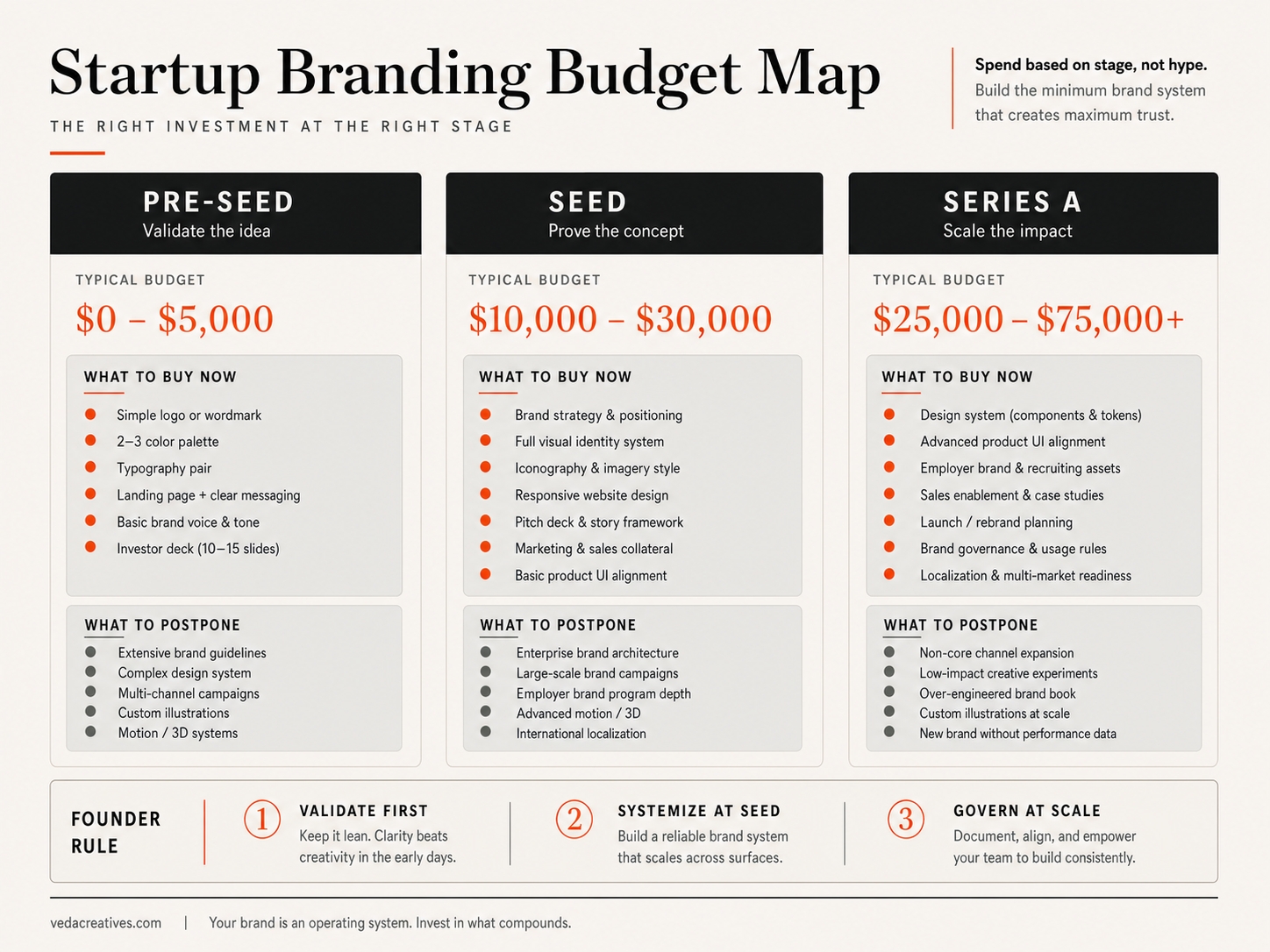
This is the more practical way to decide budget. Start with the business pressure, then buy the smallest system that can carry it.
| Company Stage | Typical Spend Range | What You Actually Need | What Can Wait |
|---|---|---|---|
| Pre-seed | $0 - $5,000 | clear wordmark, disciplined landing page, simple voice rules, basic pitch polish | broad campaign assets, complex design systems, heavy guideline documents |
| Seed | $10,000 - $30,000 | positioning, visual identity system, website design direction, investor deck support, reusable templates | broad global campaign rollout, large-scale employer brand programs |
| Series A | $25,000 - $75,000+ | stronger governance, expanded asset library, product UI alignment, recruiting assets, launch planning | low-value decorative extras with no operational use |
If your scope and spend do not match your actual stage, the project usually feels painful. Either the system is underbuilt, or the company bought deliverables it cannot maintain yet.
The Real Cost Breakdown: Where the Money Goes
Founders often ask why a professional branding project can cost five figures when a logo generator is almost free. The answer is simple: the labor is not in drawing one symbol. The labor is in reducing decision risk across the whole brand.
Here is a realistic way to think about a $20,000 boutique studio project.
1. Strategy and positioning work
This is the part most founders underestimate. The team reviews competitors, audience language, promise gaps, and category patterns. If this stage is weak, every later design choice becomes less useful because the visuals are built on vague thinking.
Typical work includes:
- founder interviews
- competitor audit
- messaging pillars
- value proposition shaping
- tone and proof-point direction
2. Identity concept development
Once the strategy is clearer, the studio builds visual routes. This includes logo directions, typography pairing, color logic, and layout rhythm. Premium work is not just “make it clean.” It is deciding what the brand should feel like and what it should deliberately avoid.
3. Refinement and system building
This is where many cheap packages stop early. Better projects do not end at concept selection. They continue into:
- logo variations
- spacing and misuse rules
- color roles
- typography hierarchy
- icon or imagery direction
- base application examples
4. Product and web alignment
A tech startup often needs the identity to show up in UI, not just in a PDF. That means more work translating brand decisions into product-friendly structures like tokens, reusable component logic, screenshot style, and layout rules. If your team needs that bridge, our UI/UX design services page shows what implementation-ready handoff should actually include.
5. Asset packaging and handoff
This is the least glamorous part and one of the most valuable. If the files are messy, missing, or undocumented, your team pays the cost later. Good handoff reduces confusion for engineers, marketers, recruiters, and future designers.
What founders are paying for is not visual decoration alone. They are paying for a sequence of decisions that lowers future inconsistency.
How to Compare Two Branding Proposals Without Guessing
One of the most common founder problems is not a missing quote. It is having two very different proposals that both sound good.
This is where social threads get noisy. One founder says a studio quote is overpriced. Another says a cheap freelancer was a disaster. Both can be right because they may have purchased completely different scopes.
If you are still asking how much does professional branding cost for a tech startup, this comparison step matters more than chasing an average market number. The better question is whether each quote solves the same business problem.
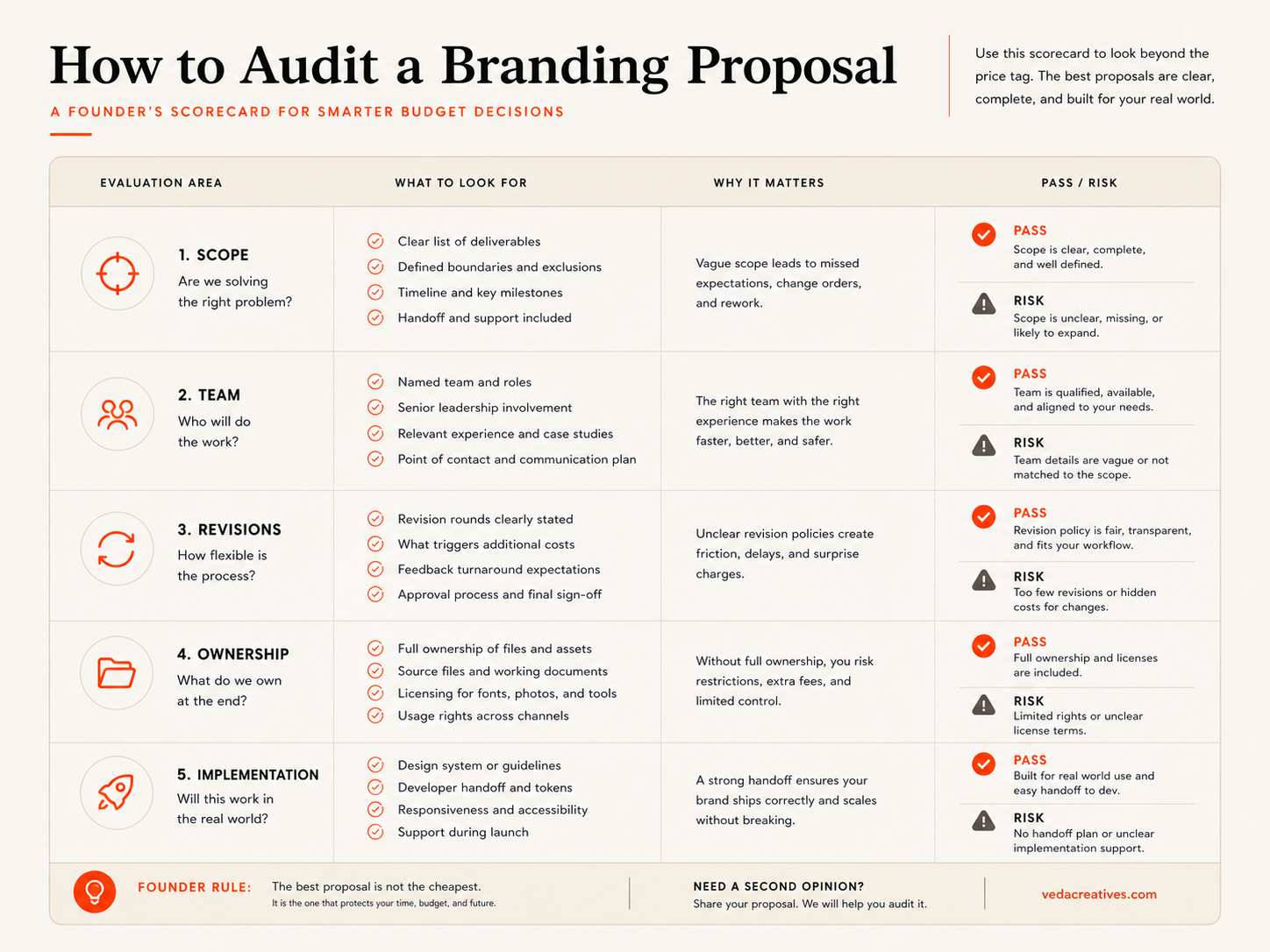
Use this five-step comparison instead of comparing only the headline number.
1. Compare scope line by line
Put the proposals side by side and list what each one includes:
- strategy
- messaging
- logo system
- typography
- templates
- web layouts
- product UI alignment
- handoff
- launch support
If one proposal looks much cheaper, there is usually a missing layer.
2. Compare who actually does the work
Ask who is pitching, who is designing, who is presenting, and who is handling revisions. A senior-led process and a junior-heavy production process should not be priced the same.
3. Compare revision logic
One quote may appear generous until you notice it includes only one revision round. Another may cost more but include better collaboration and fewer change-order surprises.
4. Compare file ownership and exit risk
A founder should be able to leave the project with usable assets, not dependency. If one proposal leaves source files vague, it is riskier even if it is cheaper.
5. Compare implementation value
The most useful proposal is not always the one with the most deliverables. It is the one that reduces the next set of problems your team will face after launch.
A simple founder rule helps here: if you cannot explain the difference between the two proposals in one sentence, the scopes are still too vague to sign.
What Should Be Included in Brand Packages for Startups?
The phrase brand packages for startups gets used too loosely. Some partners mean a logo folder. Others mean a working system. Founders need to know the difference before comparing quotes.
A solid startup package usually includes five layers:
Strategy layer
This should answer what the company stands for, who it is for, how it wants to sound, and where it needs to position itself against competitors.
Identity layer
This includes the visual building blocks:
- primary and secondary logo versions
- typography choices
- color system
- spacing logic
- icon or illustration direction
Application layer
This is where the identity becomes useful. Common deliverables include:
- landing page layouts
- deck templates
- social templates
- business or sales collateral
- simple product screen patterns
Handoff layer
This is where premium value often appears. Founders should ask for:
- source Figma files
- vector exports
- organized naming
- asset folders
- editable templates
- notes for internal use
Governance layer
This matters more as the company grows. It can include:
- short usage rules
- do and do not examples
- content tone rules
- asset ownership clarity
- launch or rollout instructions
If a package skips the application, handoff, and governance layers, it may look cheaper only because the hard work has been pushed onto your future team.
What To Do If Your Budget Is Smaller Than Your Ambition
This is the founder question that shows up everywhere: “We know branding matters, but we simply do not have a big budget yet. What should we do first?”
The answer is to buy sequence, not fantasy.
If you have less than $2,000
Do not try to imitate a full studio engagement. Focus on:
- a sharp wordmark
- one reliable type pair
- one clean landing page
- a short voice rule sheet
Action step: write down the three trust surfaces people see first. Usually that is the website hero, the founder deck, and one product screenshot. Spend your budget there first.
If you have $5,000 to $10,000
You may be able to hire a good freelancer or do a small focused sprint. Prioritize:
- stronger visual hierarchy
- a basic but distinct identity system
- one or two templates your team will actually reuse
- cleanup of the most important public-facing assets
Action step: make a list of every asset you think you need, then cut it in half. Fund the assets that reduce confusion, not the ones that only look impressive in a folder.
If you have $10,000+
Now you can start expecting more strategic depth and better handoff. This is the point where it becomes realistic to ask for a working brand system rather than isolated files.
Action step: ask each partner to explain what your team will be able to do faster after the project is complete. If they cannot answer that clearly, the scope is still too decorative.
The discipline is simple. A smaller budget does not force weak branding. It forces stronger prioritization.
Contract Questions to Ask Before You Approve a Branding Proposal
- Do we own the raw Figma files, editable templates, and vector assets after final payment?
- Which font licenses are being proposed, and who will legally hold those licenses?
- How many revision rounds are included before change orders begin?
- Does the quote include website layouts, deck templates, or only the core identity?
- Will we work directly with the senior people who pitched the project?
- What does final handoff include for marketing and engineering teams?
- If a rebrand changes URLs or page naming, is redirect planning included?
- What happens if we need more application examples after the identity phase?
How to Choose the Right Branding Partner for Your Budget
Founders often frame the question as “What can we afford?” A better question is “What level of partner fits our current pressure?”
Choose DIY or lean help if:
- you are still testing whether the market cares
- your website is temporary
- your product direction may change in the next few months
- you need clarity more than polish
Choose a freelancer if:
- you want a cleaner look fast
- you can manage the project directly
- you already know the story reasonably well
- you are comfortable coordinating copy, web, and implementation yourself
Choose a boutique studio if:
- you need strategy and identity together
- you want direct access to senior people
- you need a system that works across web, decks, and product
- you want less founder-side coordination chaos
Choose a larger agency if:
- your launch scope is broad
- your company has more stakeholders
- you need campaign-scale support beyond the identity itself
- the management overhead is acceptable to you
The common mistake is paying for scale before you need it or paying too little when the brand has become a trust problem. The right choice is the one that solves today’s communication burden without creating next quarter’s rework bill.
Why Cheap Branding Gets Expensive Later
Cheap branding can work when the goal is speed and temporary clarity. It becomes expensive when founders expect it to behave like a durable system.
The rework bill usually shows up in one of these places:
- the website needs a redesign because the original visual system was too thin
- the product UI never matched the brand, so the customer experience feels split
- decks, sales one-pagers, and social templates all need rebuilding
- the team has no source files or reusable rules
- hiring pages look disconnected from the rest of the company
That is why the better framing is not “cheap versus premium.” It is “temporary versus durable.”
A temporary identity helps you move fast today. A durable identity helps you move without confusion later. Founders should choose intentionally between those two outcomes, not drift into one by accident. If you want to see what a more complete system looks like, our graphic design services and brand identity design service show the difference between isolated assets and a working brand toolkit.
Frequently Asked Questions About Startup Branding Costs
Is $5,000 enough for startup branding?
Sometimes, yes. A lean early-stage identity can fit inside that budget if the scope stays narrow. It is usually enough for a simple mark, disciplined typography, a small palette, and light guidance. It is usually not enough for a full strategy-plus-system engagement.
Action step: decide which three public assets matter most in the next 60 days and fund those first.
Why do branding packages for startups vary so much?
Because the word branding covers very different scopes. One proposal may include only a logo and style guide. Another may include positioning, messaging, web layouts, deck templates, product UI alignment, and handoff support.
Action step: compare deliverables line by line and mark anything related to source files, revisions, templates, and launch support.
How much does professional branding cost for a tech startup if we only need the essentials?
If you only need the essentials, the answer is usually far lower than a full studio package. A founder can often build a credible early identity with a smaller budget if the scope stays disciplined and the team focuses on the highest-trust surfaces first.
Action step: list the exact assets needed for the next launch, raise, or sales cycle, and remove everything decorative from phase one.
Should a tech startup pay for branding before product market fit?
Usually only at a lean level. Early founders need clarity and trust, but they should avoid overbuilding before product direction stabilizes. Bigger spending usually makes more sense once fundraising, recruiting, or broader go-to-market pressure increases.
Action step: treat pre-seed branding as a credibility layer, not a full identity empire.
What is the biggest hidden branding cost?
It is usually missing ownership or missing scope. Source files, font licenses, extra revisions, web applications, and migration support are common surprises when the proposal language is vague.
Action step: ask the partner to list every item that is explicitly excluded from the project before you sign.
Do founders need a full agency for startup branding?
No. Many startups are better served by a freelancer or boutique studio, especially when they want direct access to senior people and a tighter scope. A larger agency makes more sense when the rollout is bigger and more complex.
Action step: choose the smallest partner that can still solve the next stage of trust and execution problems.
What files should we receive at the end of a branding project?
At minimum, ask for vector logo exports, editable source files, organized asset folders, typography and color rules, and any templates you expect your team to reuse. If product or web handoff is part of the scope, ask for those structured files too.
Action step: put the exact file list in the contract so final delivery is not open to interpretation.
How do I know if a branding quote is too cheap to trust?
Cheap is not automatically bad. It becomes risky when the quote is vague, excludes working files, limits revisions too aggressively, or gives no clarity on who is actually designing the work.
Action step: if the quote looks low, ask what is missing rather than assuming you found a bargain.
What should founders ask on the first discovery call?
Ask how the team scopes by stage, what a successful outcome looks like, who will do the work, how handoff works, and what usually creates change orders.
Action step: end the call by asking what they would tell you not to buy yet. Good partners usually have a disciplined answer.
Should we pay more for messaging and strategy, or spend all the budget on visuals?
If the positioning is muddy, visuals alone rarely solve the trust problem. Most tech startups need enough strategy to sharpen the promise before the identity gets polished.
Action step: if your team still cannot explain the product clearly in one sentence, protect strategy budget first.
Can we split branding into phases instead of doing everything at once?
Yes, and many startups should. A phased approach often works better than forcing a giant scope too early. Start with the core identity and highest-trust assets, then expand into templates, product alignment, and launch support when the business is ready.
Action step: ask the partner to separate the proposal into phase one essentials and phase two expansion work.