
What are Branding Services for Startups?
Many founders think branding is just a logo and a color palette. This is a mistake. Professional branding services for startups build the verbal and visual blueprint of your business. If you hire a designer to draw a symbol before you define your market position, you are building on a weak foundation. At VedaCreatives, we help funded founders design clean identities and high-converting MVPs.
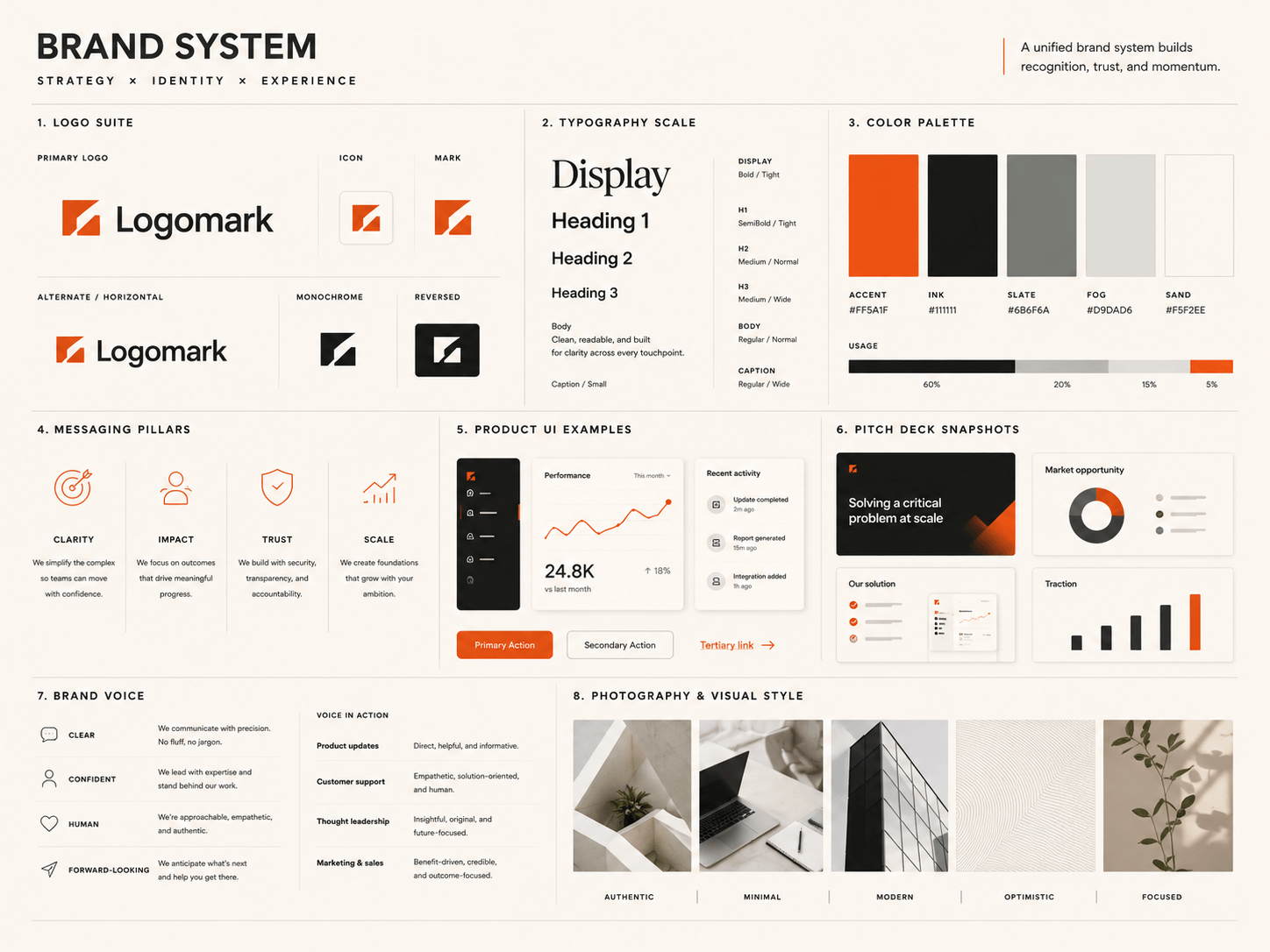
A good brand has two main parts: Brand Strategy (the words you use) and Visual Identity (the designs you see).
1. Brand Strategy (The Words You Use)
Brand strategy defines how you stand out from competitors and talk to customers. It includes these key parts:
- Mission and Values: Clear statements that explain why your company exists and how you work. Avoid generic values like “integrity” or “innovation” because they are too common and mean nothing to customers.
- Customer Personas: Profiles of your ideal buyers, showing their main problems, daily tasks, and goals.
- Positioning Matrix: A simple analysis that explains why you are the only choice for your customers.
- Messaging Pillars: Three or four core themes that guide all your marketing copy.
- Elevator Pitch: A ten-second explanation of what you do and why it matters.
2. Visual Identity (The Designs You See)
Visual identity turns your strategy into clean designs. It includes these key parts:
- Logo Suite: A main logo, a small sub-mark, and a web favicon. You need these in vector format (.SVG) so they look sharp on any screen.
- Typography: Clean fonts that are easy to read on phones and computers.
- Color Palette: A set of primary, secondary, and neutral colors that work well together and meet accessibility standards.
- Imagery Style: Rules for custom illustrations, product screenshots, and photos.
- Brand Style Guide: A short page that explains how to use these designs consistently.
To see how branding compares to marketing and product design, review the table below:
| Dimension | Brand Strategy and Identity | Growth Marketing | Product Design (UI/UX) |
|---|---|---|---|
| Main Focus | Core identity, positioning, and design systems | Customer ads, lead forms, and sales campaigns | App interfaces, user flows, and software features |
| Primary Metric | Market trust, brand recall, and price premium | Cost per lead, signups, and ad click rates | Customer retention, task success, and active usage |
| Timeline | Long-term (lasts 3 to 5 years) | Short-term (weekly updates, monthly campaigns) | Continuous updates based on customer feedback |
| Key Deliverable | Style guides, logo assets, design tokens | Ad banners, marketing copy, email newsletters | Interactive mockups, button libraries, design systems |
| Funding Phase | Seed / Series A (larger investment) | Ongoing (grows with sales revenue) | Pre-Seed to Growth (ongoing engineering work) |
Use this as a founder planning guide when comparing strategy, design, and handoff effort.
| Workstream | Suggested Share | Why It Matters |
|---|---|---|
| Strategy and Positioning | 35% | This is where category clarity, message discipline, and trust logic get set before visuals are applied. |
| Visual Design and Assets | 40% | This covers the identity system, website-facing assets, presentation materials, and reusable visual patterns. |
| Web and Token Handoff | 25% | This keeps the brand usable in Figma, product UI, and engineering handoff instead of dying at delivery. |
This is not a universal formula. It is a practical split for founders who need the brand to work across positioning, design assets, and product handoff instead of stopping at logo delivery.
Common Startup Branding Mistakes That Slow Growth
Most brand problems do not begin with color or typography. They begin when founders mistake momentum for clarity. A startup can move fast and still create a mess that becomes expensive later. The most common branding mistakes look harmless in the first month, but they create drag across product, sales, recruiting, and launch work by month six.
Mistake 1: Treating the Logo as the Entire Brand
This is the oldest startup branding mistake. A founder gets a wordmark, picks two colors, and assumes the company is now “branded.” Then the first sales deck, landing page, waitlist, and product UI all get built from scratch with no shared rules. The result is visual drift. Different text sizes. Different button styles. Different copy tone. Different screenshot treatment. A logo does not solve that.
Mistake 2: Copying the Competitor That Looks Most Legitimate
This feels safe, especially in SaaS. A founder sees a clean competitor with navy gradients, dashboard screenshots, and geometric sans type. They copy the surface language because it looks credible. The problem is that borrowed aesthetics create borrowed positioning. If you look exactly like the category leader, you do not look like the better option. You look like the smaller version.
Mistake 3: Buying Design Files Without Buying a System
Many startups pay for assets but not for maintainability. They receive logo exports, a short PDF, and a few polished mockups. Nothing is mapped to components. Nothing is tied to token names. No one writes down how the brand should behave in a pitch deck, social graphic, dashboard empty state, or hiring page. The files look complete on handoff day, but the system falls apart the moment a new teammate touches it.
Mistake 4: Investing Too Early in the Wrong Layer
Pre-seed teams often overspend on polish when they still need product clarity. The opposite mistake also happens. Seed-stage teams keep using the same loose identity they made in a weekend, even after they start selling into higher-trust environments. The right move is not “brand early” or “brand later.” The right move is to invest in the layer the business now depends on.
Mistake 5: Letting AI Accelerate Unclear Thinking
AI tools can generate names, copy, layouts, and code quickly. They can also multiply confusion. If your positioning is vague, AI will produce polished vagueness at scale. If your design rules are weak, AI builders will output templated sameness faster than a human ever could. Speed is useful only when the direction is strong.
For founders, the practical rule is simple. Every branding decision should reduce future inconsistency, not produce more of it.
When Startups Should Invest in Branding
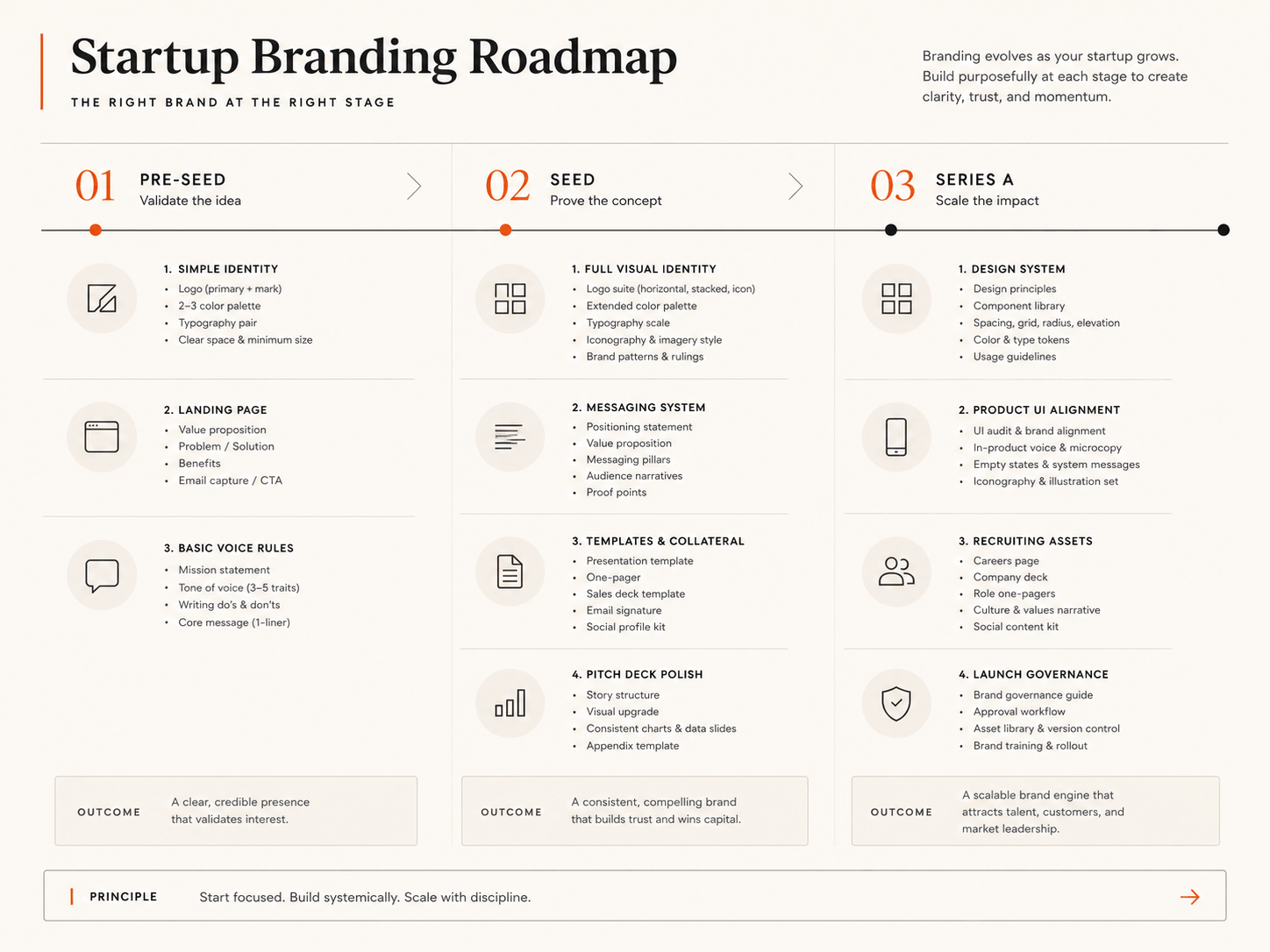
Founders ask this in the wrong way. The question is not “Should we brand early or late?” The better question is “What level of brand system does our next stage require?” A pre-seed company validating an idea does not need the same investment as a seed-stage startup selling into enterprise buyers. The system should mature with the business.
That is why good branding services for startups should always be scoped by stage. The deliverables, budget, and level of rigor should change as trust requirements change.
Pre-Seed: Build Clarity, Not Theater
At pre-seed, your job is to explain the product clearly and make the company look intentional enough that early users, pilot customers, and investors do not dismiss it. You usually need a clean wordmark, one reliable type system, a restrained color palette, a simple landing page, and a short voice rule set. You do not need a huge manual. You do need consistency.
Seed: Build Trust Across More Than One Surface
Once the company is hiring, raising, pitching, or running outbound sales, the loose early identity starts breaking. Now the same brand has to work in a landing page, a deck, a product UI, a candidate-facing page, a founder profile, and launch assets. This is where full branding services for startups become worth it. You are no longer buying only polish. You are buying operating consistency.
Series A and Beyond: Build a System That Scales Without You
At Series A, the question changes again. The founder is not the only one touching the brand anymore. Sales, marketing, design, product, and operations all start producing public-facing material. At this stage, the brand system has to hold up even when the founder is not personally reviewing every page. That means templates, shared rules, tokenized design choices, and clear ownership.
A Useful Test
If your current identity creates hesitation in fundraising, slows enterprise trust, confuses new hires, or makes every asset feel custom-built from scratch, the company is ready for the next layer of branding investment.
Review the stage table below before deciding whether to stay lean, hire a freelancer, or work with a boutique studio.
| Startup Stage | What You Need Right Now | Best Fit | What To Avoid |
|---|---|---|---|
| Pre-Seed | Clear positioning, simple identity, one landing page, one deck style | Founder-led setup or a focused freelancer | Paying for a large rebrand before market clarity |
| Seed | Full visual identity, messaging system, templates, pitch support, website polish | Boutique studio or senior independent brand partner | Running enterprise sales with a loose DIY identity |
| Series A | Design system, product UI alignment, recruiting assets, launch consistency | Boutique studio with product handoff strength or a larger retained partner | Relying on scattered decks, ad hoc landing pages, and undocumented rules |
| Multi-product or rebrand phase | Migration planning, internal rollout, external launch, asset governance | Studio or team that can manage both identity and rollout complexity | Treating rebrand as a logo swap |
Deciding Your Startup Branding Budget: Stage-by-Stage Cost Tiers
One of the most common questions founders ask when researching branding services for startups is: how much should we spend? Your budget must map directly to your business funding stage. Spending too much money early is a waste, but spending too little later creates design debt. Understanding the complete brand identity design process helps you allocate your design budget more efficiently.
Pre-Seed and Bootstrapping: Keep it Lean ($0 – $1,000)
At this stage, you are still validating your product. Do not spend your cash on custom design agencies. Use clean system typography, a simple word mark, and a basic color palette. Focus your cash on building your product and talking to early users.
Seed Stage: Building Market Trust ($10,000 – $30,000)
Once you raise your seed round, you must stand out. You need a custom brand strategy, a complete visual identity system, investor pitch decks, and a clean marketing website to attract partners and enterprise clients.
Series A and Scaling: Category Domination ($50,000+)
You now have product-market fit. You need a design partner to help you scale your brand globally. This tier includes extensive market research, corporate rebranding, and custom design tokens that keep your internal design and engineering teams aligned.
Review the table below to compare branding partners, costs, timelines, and deliverables:
| Partner Type | Typical Cost | Timeline | Key Deliverables | Major Risks |
|---|---|---|---|---|
| DIY / Fiverr | $0 - $1,000 | 1-2 weeks | Basic logo, generic colors, stock icons | High risk of trademark overlap, copied templates, zero strategic research |
| Freelance Designer | $2,000 - $7,000 | 2-4 weeks | Logo suite, basic typography guidelines, color palette | High project management overhead for the founder, inconsistent support |
| Boutique Design Studio | $10,000 - $30,000 | 4-6 weeks | Brand positioning strategy, logo suite, Figma tokens, website design, pitch deck | Limited project capacity (must schedule in advance) |
| Creative Agency | $50,000+ | 8-12 weeks | Full market research, corporate rebranding, global media assets, PR launch packages | High overhead costs, slow iterations, communication handled by managers rather than designers |
The Real Cost Breakdown: Where Does the Money Go?
Founders often ask: “Why does a professional brand cost $20,000 when a logo generator costs $50?”
When you hire a boutique design studio, you are not paying for a single graphic. You are paying for a strategic process that aligns your business goals with customer expectations.
Founders comparing branding services for startups should look at labor, decision quality, and handoff depth, not just the number on the proposal. Here is how a standard $20,000 branding project allocates labor hours:
1. Brand Strategy and Competitor Audit (35 Hours)
Before drawing any designs, the studio conducts research. They analyze your competitors to find an open space in the market. They define your positioning statement, messaging pillars, brand voice, and customer personas.
2. Concept Development and Design Curation (40 Hours)
The design team sketches visual directions. They test color palettes for readability and accessibility under WCAG contrast standards. They select typography pairings and create logo concepts that work in dark and light modes.
3. Asset Refinement and SVG Exports (35 Hours)
The selected concept is refined. Every line and curve is adjusted for mathematical alignment. The logo suite is exported in scalable vector formats (.SVG) so it loads quickly and looks sharp on high-resolution displays.
4. Design System Tokens and Coding Setup (30 Hours)
The studio builds a Figma component library. They map colors and typography to variables (tokens) that link directly to your software code, allowing your engineers to import styles via CSS variables.
5. Web UI/UX and Launch Support (40 Hours)
The team designs your landing page, configures marketing layouts, and packages your visual assets for social media and product launches.
This totals 180 hours of custom work by experienced principal designers, with zero junior outsourcing.
What a Launch-Ready Brand System Actually Includes
This is where many founders get misled. A launch-ready brand system is not the same thing as a folder of polished assets. It is a package that can be used repeatedly without needing the original designer in every room. If your team cannot open the files, follow the logic, and produce consistent outputs across channels, the system is incomplete.
Strong branding services for startups package the system in a way that non-designers can actually use. That is the difference between a portfolio-ready presentation and a working operating asset.
The Minimum Deliverables a Founder Should Expect
A real brand system should include your logo suite, typography rules, color roles, spacing logic, imagery direction, and basic do-not-do examples. It should also include working templates for the places where trust is won or lost fastest: decks, landing sections, product screenshots, social announcement graphics, and hiring materials.
What Makes a System Usable Instead of Decorative
Usability comes from naming, structure, and repeatability. Colors should not be saved as random hex notes. They should be named by function. Buttons, cards, badges, and screenshots should not all be treated ad hoc. They should follow shared component logic. Voice should not live in the founder’s head. It should be documented in examples that new teammates can use on day one.
The Handoff Layer Most Teams Skip
The bridge between identity and execution is where most brand systems fail. Founders need Figma files that are organized, editable, and tied to real use cases. They need exports prepared for web, deck, and social use. They need a clear rule for who owns updates after launch. Without this layer, the brand looks good in review meetings and weak everywhere else.
A Simple Way To Audit Your Current System
Ask your team to create three assets without talking to the original designer: a landing page hero, a hiring graphic, and a sales slide. If each asset looks like it came from a different company, the system is not ready yet.
This is also why the cost spoke matters. If you want a deeper breakdown of deliverables, ownership, and hidden fees, read our detailed guide on startup branding costs and package logic.
How Branding Services for Startups Influence Venture Capital Pitching
Early-stage venture capital is a game of credibility. When you pitch a VC, you are not just presenting a spreadsheet of metrics. You are presenting your team’s capability to execute.
If your pitch deck uses default templates with inconsistent fonts and messy spacing, VCs will notice. They assume that if you cannot oversee the quality of your pitch presentation, you will also fail to manage the quality of your product codebase.
1. Proving Execution Capability through Visual Trust
A clean, professional brand system signals operational maturity. It tells investors that you have backing and that you take your business seriously. It lifts your startup out of the “hobbyist” category and establishes you as a credible competitor.
2. The Intangible Asset of Brand Equity
A strong brand is an asset that directly impacts your company valuation. It allows you to command higher prices, reduces your customer acquisition costs, and increases customer retention. When VCs evaluate your business, they factor this brand equity into their investment decisions.
The Storytelling Structure of a Series A Pitch Deck
When designing your pitch deck, you must apply your visual identity consistently across these 10 core slides:
- Cover Slide: A clean title showing your new word mark and a 10-word summary of your business.
- The Problem: A layout focusing on a single, clear pain point. Avoid crowded bullet points.
- The Solution: A slide presenting your software platform using custom diagrams.
- Market Opportunity: A simple visualization showing your Total Addressable Market (TAM).
- Product Demo: High-resolution screenshots of your product running in custom browser mockups.
- Business Model: A table outlining your pricing structure and average customer value.
- Competition: A clean matrix comparing your features and positioning with competitors.
- Go-to-Market Strategy: A timeline outlining your user acquisition plan.
- The Team: Photos of founders with simple bios and logos of past companies they worked at.
- The Ask: A slide showing your fundraising target and key hiring and expansion milestones.
How Branding Services for Startups Shape Product UX Design
Many startups face a design gap. The branding agency delivers a style guide, but the software engineers build the product using their own styles. This makes the product look inconsistent, which hurts user trust.
The best branding services for startups close that gap instead of pretending it is someone else’s problem.
To fix this, you must connect your brand design directly to your product code.
1. Figma Design Tokens
Do not leave your brand guide in a static PDF. Set up variables in Figma for:
- Colors: Use names (like
brand-primaryorbackground-dark) instead of raw hex codes. - Spacing Grids: Use an 8px grid system (like
space-8,space-16,space-24) to keep layouts aligned. - Typography: Create text sizes that adapt easily to phones and desktop screens.
2. Clean Code Handoff
Your Figma styles should map directly to your code:
- CSS Variables: Set up your project to read colors and text styles as simple variables.
- Tailwind Integration: Configure your styling files to read these variables. This allows developers to build responsive pages that match your brand rules automatically.
Building custom design systems in Figma bridges the gap between static design specs and active codebases.
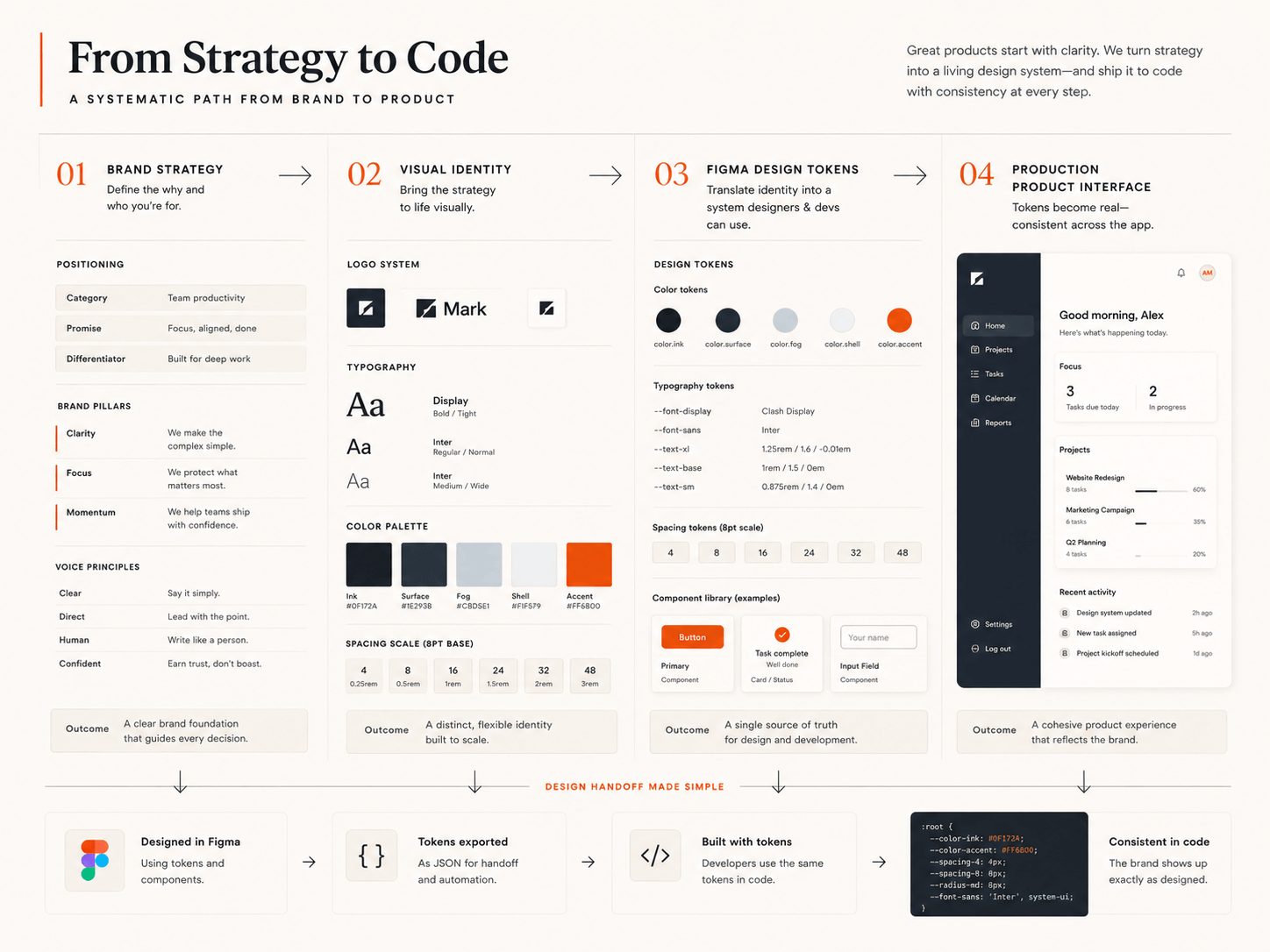
The sequence below shows how brand strategy turns into production code:
A founder-friendly view of the design-to-code handoff.
| Step | Focus | What Gets Locked In |
|---|---|---|
| Step 1 | Brand strategy | Positioning, audience clarity, value story, and voice rules |
| Step 2 | Visual identity | Color roles, type hierarchy, spacing logic, screenshots, and UI tone |
| Step 3 | Figma token system | Variables, components, states, naming, and shared implementation rules |
| Step 4 | Code handoff | CSS variables, Tailwind config, component usage, and production UI checks |
Vibe Coding: Integrating MVP Development with Human Design Craft
The rise of AI developer tools has changed how startups write code. Using natural language prompts, founders can now build functional prototypes in a single weekend. This process of MVP development for startups is called vibe coding.
While vibe coding offers incredible speed for database setup and backend logic, it also creates a risk called agentic technical debt.
This matters to branding services for startups because design debt and code debt quickly merge. If the product ships with inconsistent components, weak states, and generic layouts, the brand promise breaks inside the interface.
Managing Agentic Technical Debt and Code Drift
AI models operate as local optimizers. They edit the specific file you open, but they do not understand the broader architecture of your codebase. Over time, this leads to duplicate helper functions, conflicting styles, and code drift.
To prevent your software from collapsing, you must enforce strict guidelines:
- Rules Files: Add a
.cursorrulesorCLAUDE.mdfile to your root directory defining your coding standards. - Refactoring Sprints: Schedule a weekly cleanup session to prune unused code and consolidate Tailwind styles.
- Modular Architecture: Build your application in small, testable files rather than massive single scripts.
Here is an example of what to include in your .cursorrules file:
Why AI Website Builders Fail
Many automated branding tools promise to design complete brand identities and websites. However, these tools rely on generic templates. They generate layouts that look identical to thousands of other companies.
Furthermore, automated designs frequently fail basic accessibility contrast tests, making your product unusable on mobile screens. A premium brand requires human design systems to connect your visual strategy to your code using custom Figma tokens.
The Developer-Ready Design Handoff Protocol
To make sure your developers build interfaces that match your design specifications, follow this handoff protocol:
- Figma Variable Setup: Link all layout colors, paddings, and font styles to active Figma variables.
- Interactive States: Design and document hover, focus, disabled, and loading states for every button and input field.
- Vector Asset Export: Minify and export all logo variants and custom icons as .SVG files, stripping out unnecessary metadata.
- Tailwind Configuration Sync: Export design variables as a JSON theme configuration file that maps directly to the tailwind.config.js file in your codebase.
What a `.cursorrules` file should cover
- Define the app framework clearly, for example
Next.js with App Router, so everyone builds inside the same architectural assumptions. - Lock in your database choice early, such as
Supabase PostgreSQL, to stop AI tools from inventing mismatched data patterns. - State your styling rule directly, such as
Tailwind utility classes only, so the codebase does not drift into random inline styling. - Set code-quality expectations like small files, clear naming, and testable components.
- Require strict TypeScript usage so shortcut code does not silently weaken the project later.
- Tell the team to export visual tokens as CSS variables so the design system actually survives implementation.
Brand Voice and Copywriting: Writing a Tone of Voice Guide
Your verbal identity is just as important as your visual design. Many tech companies use complex language that confuses readers, contributing to the rise of AI slop in branding. A premium brand voice must be direct, simple, and proof-led.
This is another place where branding services for startups either create real value or stay superficial. If the visual identity sharpens up but the copy still sounds like a templated SaaS clone, the market still experiences the brand as generic.
Exposing the ChatGPT Copywriting Style
With the popularity of AI writing tools, SaaS copywriting has become highly generic. Default AI models write copy using repetitive buzzwords.
To stand out, you must ban these terms from your marketing copy and AI prompts:
- Seamless: Replace with “direct” or “easy.”
- Robust: Replace with “secure” or “reliable.”
- Elevate: Replace with “improve” or “speed up.”
- Unlock: Delete this word entirely from your text.
The Mirroring Guide for Tech Copy
To keep your writing team aligned, create a mirroring chart that shows off-brand (avoid) copy next to on-brand (preferred) copy:
- Avoid: “We leverage cutting-edge AI integrations to optimize your robust data systems.”
- Preferred: “Our database syncs your customer information in real-time, even when offline.”
Three Practice Exercises: Feature to Benefit Translation
To train your team in this style of writing, run these translation exercises:
- Security: Convert “Our software utilizes state-of-the-art compliance encryption protocols” to “We encrypt your data using SOC-2 standards to keep your customer information private.”
- Speed: Convert “We offer lightning-fast page speed optimizations via edge network caching” to “We cache your pages on global servers. Your website loads in under 1 second.”
- Database Failover: Convert “Our database schemas offer robust failover support to maximize uptime” to “We clone your database across three active servers. If one server goes offline, your app stays active with zero data loss.”
How Branding Services for Startups Support Employer Branding
When hiring early-stage engineers and designers, you face a trust deficit. High-quality candidates are cautious about joining startups due to the risk of business failure.
That is why branding services for startups affect recruiting, not just marketing. Strong employer-facing assets help candidates judge whether the company is thoughtful, stable, and worth the career risk.
To hire successfully, your career page must act as a risk assessment tool that projects safety and stability.
1. Visual Credibility in Recruitment
If your recruitment page looks unpolished or uses stock photos, candidates will assume your business lacks backing. A custom visual identity, real employee team photos, and clean typography tell candidates that your startup is stable and operational.
2. Defining Communication SLAs and Process
Remove the mystery from your application process. Explicitly outline your hiring stages and state a response time SLA (such as “we respond to every resume within 5 business days”).
3. Transparent Option and Equity Math
Do not hide options details behind vague promises. Provide a clear explanation of your 4-year vesting schedule and your 1-year cliff. Show how stock option values change as your company valuation grows:
- Option Grant: 10,000 shares
- Strike Price: $1.00 per share
- Series A Valuation (Share price: $5.00): Options value is $50,000
- Series B Valuation (Share price: $15.00): Options value is $150,000
- Exit / Acquisition (Share price: $40.00): Options value is $400,000
How Branding Services for Startups Support Launch PR and SEO Migration
A successful rebrand or brand launch requires a coordinated PR rollout. If you launch your new brand without warning your customers or updating your local listings, you will cause market confusion.
If your branding services for startups include a rename, a new domain, or a public repositioning, rollout planning has to be part of the engagement rather than an afterthought.
Phased Rollout Sequence
Do not announce your brand to the public immediately. Follow a sequenced rollout:
- Internal Team: Train your employees on the new brand values and visual assets.
- Key Partners: Brief your top customers and investors to explain the rationale.
- Public Launch: Distribute your announcement across Product Hunt, social networks, and tech media.
The Technical SEO Rebrand Checklist
If your brand launch involves moving to a new domain name, you must follow a technical migration plan to protect your Google rankings:
- 1-to-1 Mapping: Audit your old site and map every single URL to its new equivalent. Avoid redirecting all pages to the homepage.
- 301 Redirects: Execute permanent redirects; do not use temporary 302 redirects.
- Avoid Chains: Ensure redirects point directly from the old URL to the final new URL with zero intermediate hops.
- GSC Change of Address: Submit the change in Google Search Console and keep the old domain redirects active for at least 180 days.
- NAP Citation Sync: Update your Name, Address, and Phone listings across business directories to prevent listing suspension.
Code Templates for Server Redirects
If you use Next.js or Nginx, keep the redirect logic simple, direct, and easy to audit.
Redirect implementation rules
- In
Next.js, keep one direct redirect entry where the old blog path maps straight to the new destination and the redirect is marked permanent. - In
Nginx, return a direct301from the old host to the new host while preserving the original request URI. - Avoid redirect chains, wildcard shortcuts that collapse many pages into one, or temporary redirects during a permanent rebrand.
- Test every important legacy URL after launch so high-value pages, backlinks, and campaign assets still land in the right place.
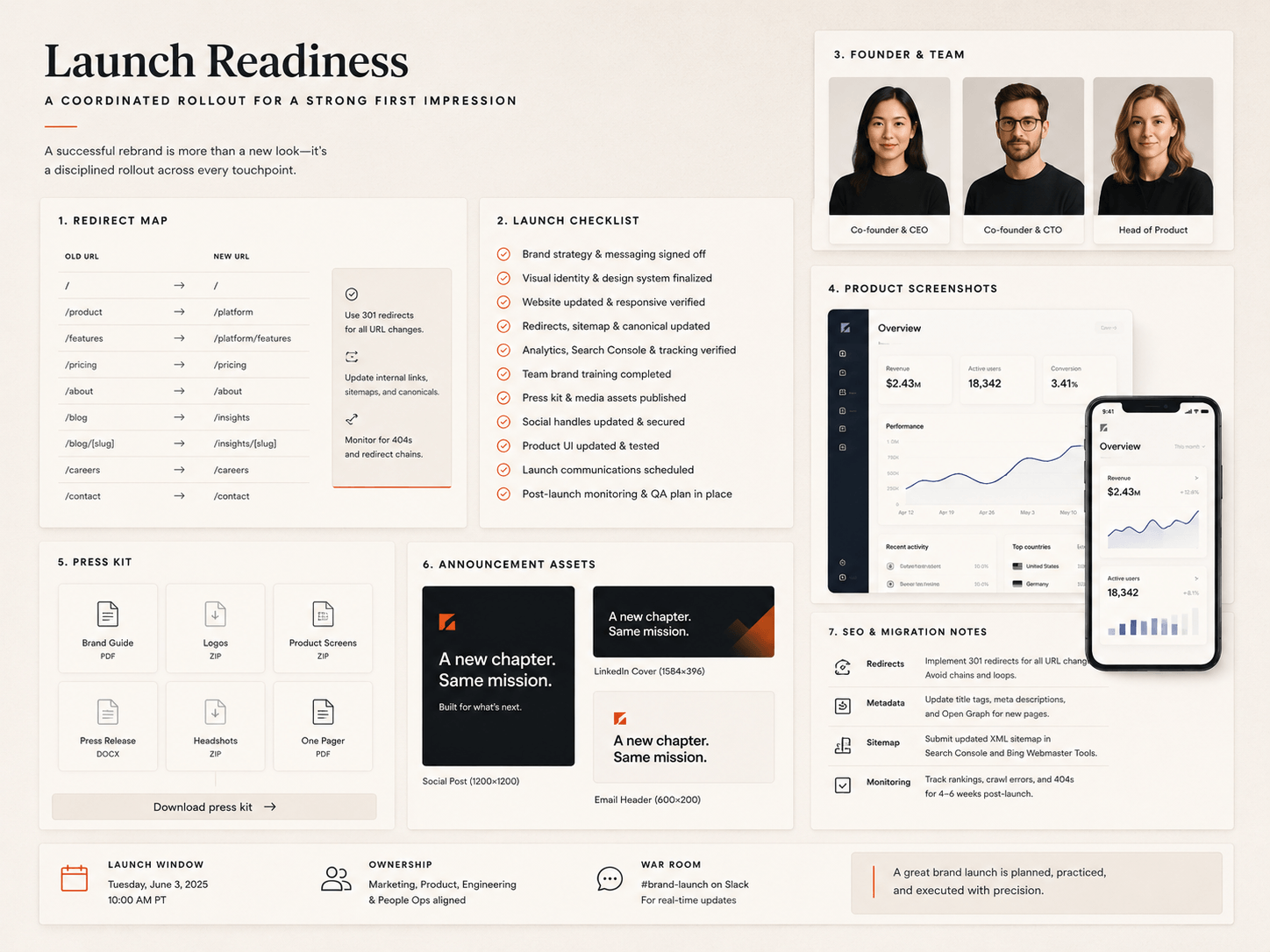
How to Keep Your Brand From Drifting After Launch
A brand system can look perfect on launch day and still decay quickly if no one owns governance. Drift begins when each team starts making “small exceptions” for speed. Sales edits deck layouts. Marketing introduces a new button style in landing pages. Product uses a different text scale inside onboarding. Recruiting builds job graphics in a separate visual language.
None of these changes feel dramatic on their own, but together they weaken trust. This is why the best branding services for startups plan for maintenance, not just reveal day.
The fix is not a giant approval process. The fix is clear ownership and reusable templates. Assign one person or one small working pair to review new public-facing assets against the system. Keep a single source of truth for token names, logo exports, copy rules, and template files.
Run a short monthly audit across your website, product UI, decks, hiring pages, and launch assets. If teams keep recreating the same asset from scratch, the system is still too hard to use.
Good governance also makes every future spoke article stronger. The cost article can reference ownership and maintenance. The brand voice article can reference copy QA. The vibe coding article can reference design-token drift. The launch article can reference rollout governance.
That is how the pillar becomes the stable center of the cluster instead of a one-time post.
Comparing Branding Companies for Startups: Studios vs. Agencies
When looking to build your brand, you will evaluate different types of partners. Comparing branding companies for startups shows a clear trade-off between speed, attention, and budget.
The real question is which version of branding services for startups your company actually needs right now: solo execution, guided strategy, or a full system plus rollout support.
- Freelancers: Low cost, but require you to manage the timeline and handoff details.
- Big Agencies: Large teams and wide capabilities, but carry massive overhead costs and move slowly.
- Boutique Studios: Capped client lists, direct designer contact, and specialized execution without agency overhead.
Vetting a Branding Agency for Startups: Traps and Red Flags
Startup founders often spend too much money on the wrong design partners. A traditional branding agency for startups charges high prices because of big offices and overhead. To hire successfully, watch out for these red flags. For technical platforms, you must hire a studio skilled in custom UI/UX design services so that your visual identity works seamlessly with your app layout.
Red Flag 1: The “Bait-and-Switch”
This is a common agency trick. Senior partners and principal designers pitch you the project. Once you sign the contract, they hand your brand to junior designers or interns.
- Solution: Make sure your contract lists the specific principal designers who will work on your brand, and request direct contact with them.
Red Flag 2: The “Yes Men”
A weak design agency will agree with every idea you have. You are hiring them for their design expertise. If they do not push back when you suggest a bad design choice, they are not helping you.
- Solution: During sales calls, ask: “Can you tell me about a time you advised a client against a design choice and why?”
Red Flag 3: Rigid Tiered Packages
Avoid agencies that sell simple, pre-packaged tiers (like Basic, Standard, Premium). A good design studio starts with a discovery phase to understand your specific market goals before setting price scopes.
To see where your budget goes in a professional branding project, review the labor table below:
Questions to Ask Before Hiring a Branding Partner
- Who will actually do the work after the sales call, and can we meet that person before signing?
- What deliverables will we receive in editable source form, not only exported files?
- How do you connect the brand system to product UI, decks, templates, and launch assets?
- What will the team need from us during discovery so the work is based on strategy instead of taste alone?
- How do you handle voice, messaging, and copy examples alongside visual identity?
- What does handoff look like once the project ends, and what can our team realistically maintain on its own?
| Project Phase | Target Hours | Main Activities | Core Deliverables |
|---|---|---|---|
| 1. Discovery and Strategy | 35 hours | Competitive research, brand positioning, value pitches, target buyer profiles | Positioning matrix, brand voice description |
| 2. Concept Development | 40 hours | Logo sketching, color curation, accessibility testing, typography design | 3 distinct visual directions |
| 3. Asset Refinement | 35 hours | Vector design, spacing grid setups, custom icon design, business card layouts | Polished logo suite (SVG), typography rules |
| 4. Design System Tokens | 30 hours | Figma library setup, variables mapping, CSS/Tailwind translation setup | Figma source file, CSS variables stylesheet |
| 5. Web Handoff and Launch | 40 hours | Landing page wireframes, high-fidelity mockups, launch PR asset package | Ready-to-build Figma layouts, PR kit assets |
| **TOTAL PROJECT TIME** | **180 hours** | **Bespoke execution with zero junior outsourcing** | **Complete launch-ready premium identity system** |
Hiring the Best Agency for Startup Brand Identity and UX Design
Your digital brand exists on your web and product screens. Hiring the best agency for startup brand identity and ux design means finding a partner that understands code as well as visual graphics.
For many software teams, that is the real separator between generic branding services for startups and useful branding services for startups. One gives you polished files. The other gives you a system your developers can implement correctly.
- Boutique Studio Model: Capping capacity to two projects per month ensures your brand and app layouts get individual principal design focus.
- Direct Developer Token Handoff: Visual designs must translate to developer-ready CSS variables and Figma tokens to prevent developer errors during coding.
Navigating Contracts: Exposing the Legal Traps
When signing a contract with a branding agency, founders often miss critical legal details. Use this checklist to protect your assets:
1. Full Source File Ownership
Make sure the contract transfers all design ownership to you once you pay.
- The Trap: Some agencies only deliver flat files (like PNGs or PDFs) and charge extra fees to release the Figma source files or vector formats (.SVG). Without these, you cannot update your designs as your product grows.
- The Checklist: Ensure your contract says: “Start-up owns all raw vector files, source Figma files, and design layers upon project completion.”
2. Font Licensing Costs
Agencies often choose expensive commercial fonts for your logo or site without checking licensing fees.
- The Trap: A font license for a web app can cost thousands of dollars per year based on traffic. If the agency does not tell you, you face unexpected bills later.
- The Checklist: Require the agency to verify font licensing costs. Use high-quality open-source fonts (like Google Fonts or FontShare) when possible, or buy the licenses directly under your company name.
3. Site Migration Redirection Map
If your branding changes your company name or domain, you face SEO traffic risks.
- The Trap: If your site moves to a new domain without a page-to-page redirect plan, you can lose over 50% of your Google search traffic permanently.
- The Checklist: Never redirect all old links to your new homepage. Require a 1-to-1 redirect map (301 redirects) and Google Search Console index checks.
One reason founders pay for branding services for startups instead of isolated design tasks is risk management. Naming, ownership, handoff, migration, and governance all have real business consequences when the company starts scaling.
Frequently Asked Questions About Startup Branding Services
Q1: When do branding services for startups become worth the budget?
Branding services for startups become worth the budget when your current identity starts slowing trust, hiring, fundraising, or product consistency. That usually happens at Seed, Series A, or the moment a founder-led visual setup no longer supports sales, recruiting, and product handoff well.
Q2: When is the absolute best time to rebrand?
You should rebrand when your current visual identity no longer reflects your business market position. This typically occurs after raising a Seed or Series A round, when transitioning from B2C to enterprise B2B sales, or when expanding your product features beyond your original name.
Q3: Do we need to trademark our logo and company name immediately?
Yes. You should perform trademark searches before launching your new brand identity. If you use a generic logo from automated generators, you face the risk of infringing on existing registered marks. A custom design from a professional studio includes comprehensive visual property audits.
Q4: Can we use open-source typography for commercial products?
Yes. Fonts available on platforms like Google Fonts or FontShare are free for commercial use. Using these open-source fonts helps you avoid expensive annual desktop and web font licensing fees.
Q5: What is the difference between a brand guide and a design token library?
A brand guide is a document explaining how to use logos and colors consistently. A design token library is a file containing design variables (colors, spacings, type scales) that translate directly into CSS variables, linking your design files to your production code.
Q6: How do we measure the Return on Investment (ROI) of branding?
While branding is a long-term asset, you can measure its impact through:
- Improved Conversion Rates: A credible website converts a higher percentage of visitors into signups.
- Reduced Sales Cycle Times: Enterprise clients buy faster when they visually trust your brand.
- Lower Recruitment Costs: Top talent applies directly to companies with polished careers pages.
Q7: Should we hire a creative agency or a boutique design studio?
Choose a boutique design studio if you want direct access to principal designers, faster iterations, and developer-ready code systems. Choose a large creative agency if you need global PR campaigns and carry a multi-million dollar budget.
Q8: What is WCAG color contrast compatibility and why is it important for our brand website?
The Web Content Accessibility Guidelines (WCAG) specify that text must maintain a contrast ratio of at least 4.5:1 against its background (or 3:1 for large headings) to remain readable for users with visual impairments. Ensuring WCAG compliance is critical to protect your brand website from usability drop-offs and potential legal accessibility challenges.
Q9: How do we synchronize our local sitemaps and search indexes after a rebrand launch?
Create a new XML sitemap containing only your updated active URLs and submit it to Google Search Console on launch day. Keep your old sitemap active on the old domain, pointing search engine crawlers to the new 301 redirect paths to ensure rapid indexing.
Q10: Can we use system fonts on a premium brand website?
While system fonts (like Arial or system-ui) are fast because they require no network download, they look generic. To build a premium identity, we recommend self-hosting a curated, high-quality typeface (such as Inter or Outfit) to balance page speed with visual prestige.
Q11: What is the risk of having a redirect chain during a domain migration?
A redirect chain occurs when a crawler has to hop through multiple links to reach a page. It wastes Google’s crawl budget, increases latency, and dilutes link equity. Ensure all redirects connect directly from the old URL to the final new URL. Additionally, a redirect loop (where URL A redirects to URL B, and URL B redirects back to URL A) will completely block search engines and users from accessing your website, resulting in immediate index removal.
Q12: How many body images should a long startup branding guide include?
A long founder guide should use only images that teach something. For this pillar, three to four body visuals are enough when paired with tables and charts. Use them to explain a stage roadmap, a brand system board, a design-to-code handoff, or a launch-readiness framework. Decorative stock images do not help the reader or the page quality.
Q13: How do we keep the pillar useful after the child posts go live?
Use the pillar as the master guide and the child posts as deep dives. Each spoke should answer one narrower founder problem in more detail, then link back to this guide. The pillar should also link outward from the matching section once each child article is published. That gives users and search engines a clean topic cluster instead of isolated posts.