
You launched fast. You used the tools. You had a Midjourney logo, a Looka color palette, and a ChatGPT-written tagline by Friday. It looked good enough, professional even. You moved on to product. Now you’re six months in. Your conversion rate is flat. An investor passed without much explanation. Your best hire chose a competitor. You’ve started to wonder if the product is really the problem.
This is for funded founders, CTOs, and operators who are asking that question about their brand. By the end of this, you’ll know exactly what AI slop in branding looks like and sounds like, what the real cost is when a brand works against you, and what specific choices actually shift the outcome. The payoff: a clear read on whether your current brand identity is an asset or a liability, and what to do about it either way.
What Is AI Slop in Branding?
“AI slop” started as a term for low-effort AI-generated content flooding platforms without adding anything real. In branding, it refers to something more specific: the visual and verbal output of generative tools used as a shortcut to identity. That’s not a moral judgment. Plenty of excellent studios use AI as part of their workflow. The slop happens when the output is the process.
When no strategic thinking, no founder story, and no differentiated point of view gets layered on top of what the model returns. Here’s the structural issue. Generative AI models are trained on existing data. They optimise for patterns that look “professional” to the average viewer. The result is an effectively unlimited supply of logos, taglines, and color systems that are aesthetically and strategically neutral.
Neutral, in a competitive market, means invisible. Invisible brands don’t get deals. They don’t attract the engineers and operators who have choices. They get compared on features and price, and that’s a race most early-stage companies can’t sustain.
7 Signs Your Brand Might Be AI Slop
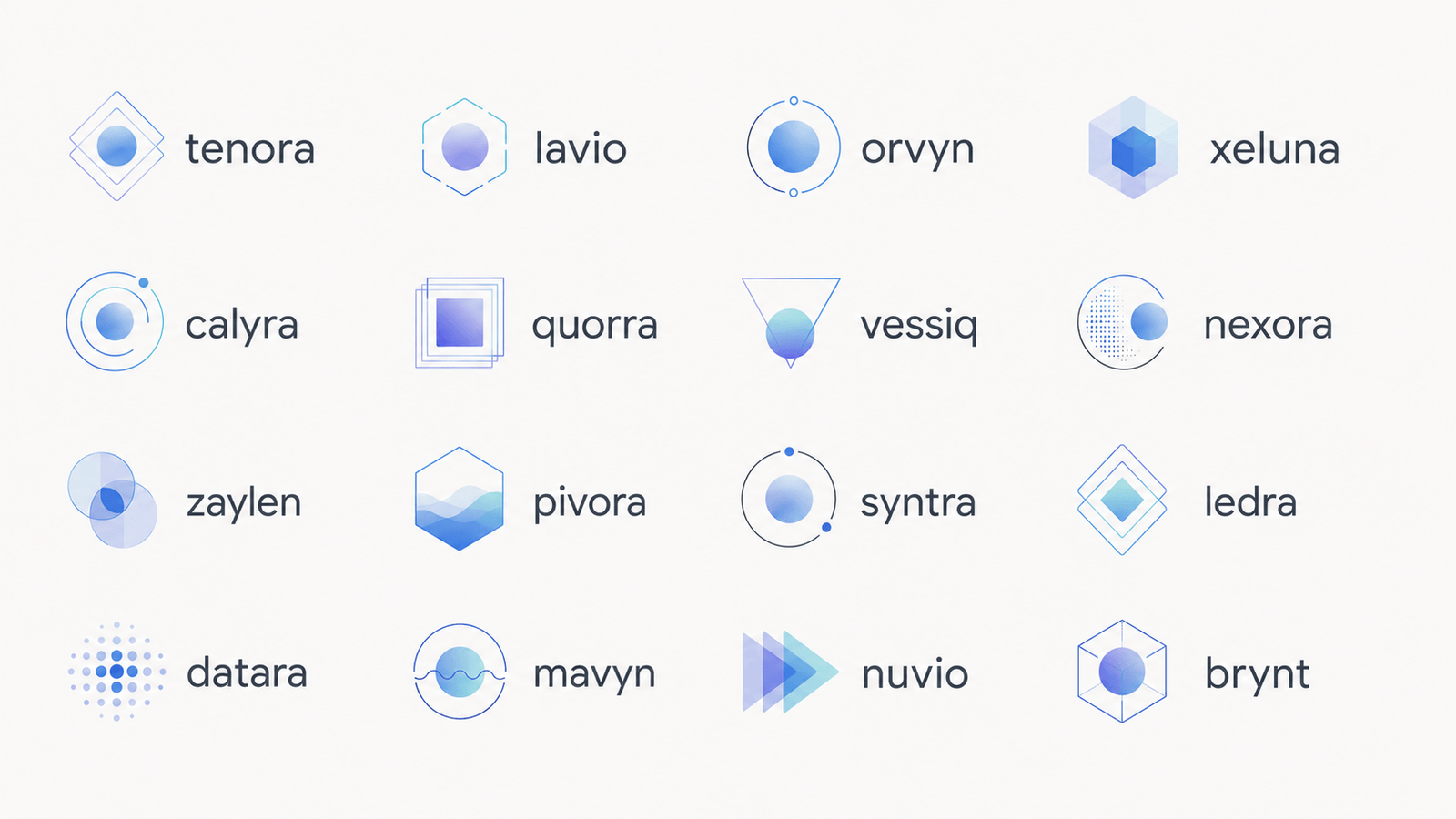
1. Your logo could belong to three different industries Take your logo and ask honestly: could this be a fintech app, a wellness platform, and a B2B SaaS tool? If yes, it’s doing no differentiation work at all. Sector-neutral design is AI’s default state. It optimises for “looks professional” over “unmistakably us.” Generic isn’t just uninspiring. It’s actively working against brand recall in a market where most buyers decide in seconds.
2. Your tagline could be reversed and no one would notice Here’s a quick test: flip your tagline. If “Build faster, grow smarter” can become “Build slower, grow dumber” without the contrast being jarring, you don’t have a positioning statement. You have polished filler. AI-generated taglines follow patterns that sound like startup language. They feel like they could apply to any company in your category, because they’re derived from the average of companies in your category.
3. You can describe your brand in three adjectives, and so can every competitor Bold. Clean. Modern. If those three words are anywhere in your brief, you’re in the majority. Every brand on Product Hunt uses some version of that triad. Real differentiation comes from specificity: “Understated and precise, for people who are tired of software that treats them like they’ve never used software before.” That kind of line can only come from a genuine point of view, not a model averaging across thousands of existing brand voices.
4. Your visual identity has no single signature element Oatly has that handwriting. Figma has the four-color logo nodes. Stripe has the diagonal gradient that’s been in every developer’s peripheral vision for years. What’s your visual signature? The one element that, seen without context, without the company name, says “us”? If you don’t have a clear answer, your brand is a collection of competent-looking assets with no connective tissue.
5. Your brand looks completely different from six months ago Quick iteration is a genuine virtue in product development. In brand, it’s a warning sign. If you’ve cycled through three logo variations and two color palettes in under a year, that’s not strategic evolution. It’s the absence of conviction in the original work. Brands need time to embed. Your audience needs repetition to build recognition. Every pivot resets that clock.
6. Nobody outside your team mentions your brand unprompted Genuine brand equity shows up in conversations you’re not part of. Someone tells a colleague, “You should see what they look like, it’s really distinct.” AI slop brands don’t generate that. There’s nothing sufficiently distinctive to notice, so there’s nothing to remember or repeat. If your brand never comes up organically in the conversations that matter, it’s not because people aren’t paying attention.
7. Your brand assets give you a mild sense of embarrassment This sounds soft but it isn’t. Founders working with strong brand identities talk about their assets with quiet, unselfconscious confidence. They actively like putting their website and deck in front of investors, candidates, and clients. If you have a low-grade reluctance about sending your homepage link, or you find yourself pre-apologising for the design in a deck, that feeling is usually data worth taking seriously.
The Economics Behind the Shortcut
The math on AI brand tools is obvious. Looka charges around $65 for a full logo pack. Midjourney is $10 a month. ChatGPT can write a first draft of your brand story in four minutes. For a pre-seed startup watching every dollar of runway, that’s a completely rational choice. But the calculus changes the moment you have something to protect.
To illustrate with a hypothetical: imagine a B2B SaaS startup, call them Finlo, that raises a $1.8M seed round. They launch with an AI-generated identity: a geometric logomark in blue-grey, a clean sans-serif wordmark, and a homepage that looks like the median B2B SaaS tool released that year. The product is solid. NPS sits at 42. But the pricing page has a 74% drop-off rate.
When they eventually run a brand audit, the issue isn’t the product. Their brand communicates nothing about why they’re the right tool for a specific type of customer. They look like a commodity, so buyers are treating them like one. Repricing upward is very difficult when your brand has already anchored you at “one of many.” The eventual rebrand costs them around $22,000.
They’d saved $65 upfront and spent roughly 337x that to correct course, plus the opportunity cost of operating at the wrong price point for eight months while the problem compounded. The ratio plays out differently for every company. The direction is always the same.
What It's Actually Costing You
The cost of AI slop in branding isn’t usually a single catastrophic failure. It accumulates as friction in the specific places that matter most to a growing startup. Longer sales cycles. When buyers can’t immediately understand why you’re different, they default to comparison shopping and additional due diligence. Every extra week in a sales cycle is burn you could have avoided with clearer positioning.
Lower conversion rates on every channel. Generic landing pages convert worse than specific ones. Specificity builds faster credibility. If your value proposition reads like it could apply to four different product categories, a meaningful percentage of qualified visitors won’t bother digging deeper. A harder investor narrative. Investors have seen thousands of pitch decks.
A brand that looks like the median startup doesn’t help your story. It creates a background question of “why are these people different?” that has to be answered through conversation rather than the shorthand a strong brand provides. That costs time and reduces your conversion rate on closes. Talent acquired at a discount. The strongest engineers, designers, and operators have real choices.
Your brand is part of your offer. A coherent, distinctive identity signals that the founders know who they are and are building something worth joining. Weak brand sends the opposite signal. Permanent price compression. Brands without differentiation compete on features. Features are copyable. Price becomes the easiest lever for a buyer comparing you to anyone else in the category. Once you’re in a price conversation you didn’t want, it’s very difficult to exit.
Here's how the two approaches compare across the dimensions that affect business outcomes most.
| What You're Comparing | AI-Generated Brand | Strategy-Led Brand |
|---|---|---|
| Visual signature | Generic, sector-neutral | Distinct and ownable |
| Positioning | Sounds like every competitor | Specific and defensible |
| Tone of voice | Category language | Specific personality |
| Rebrand risk | High — no strategic anchor | Low — built on real strategy |
| Cost of mistakes | $10K–$25K+ rebrand down the line | Amortised over the lifecycle |
| Investor first impression | Blends into the field | Stands out, prompts the right questions |
When AI Can Help and When It Can't
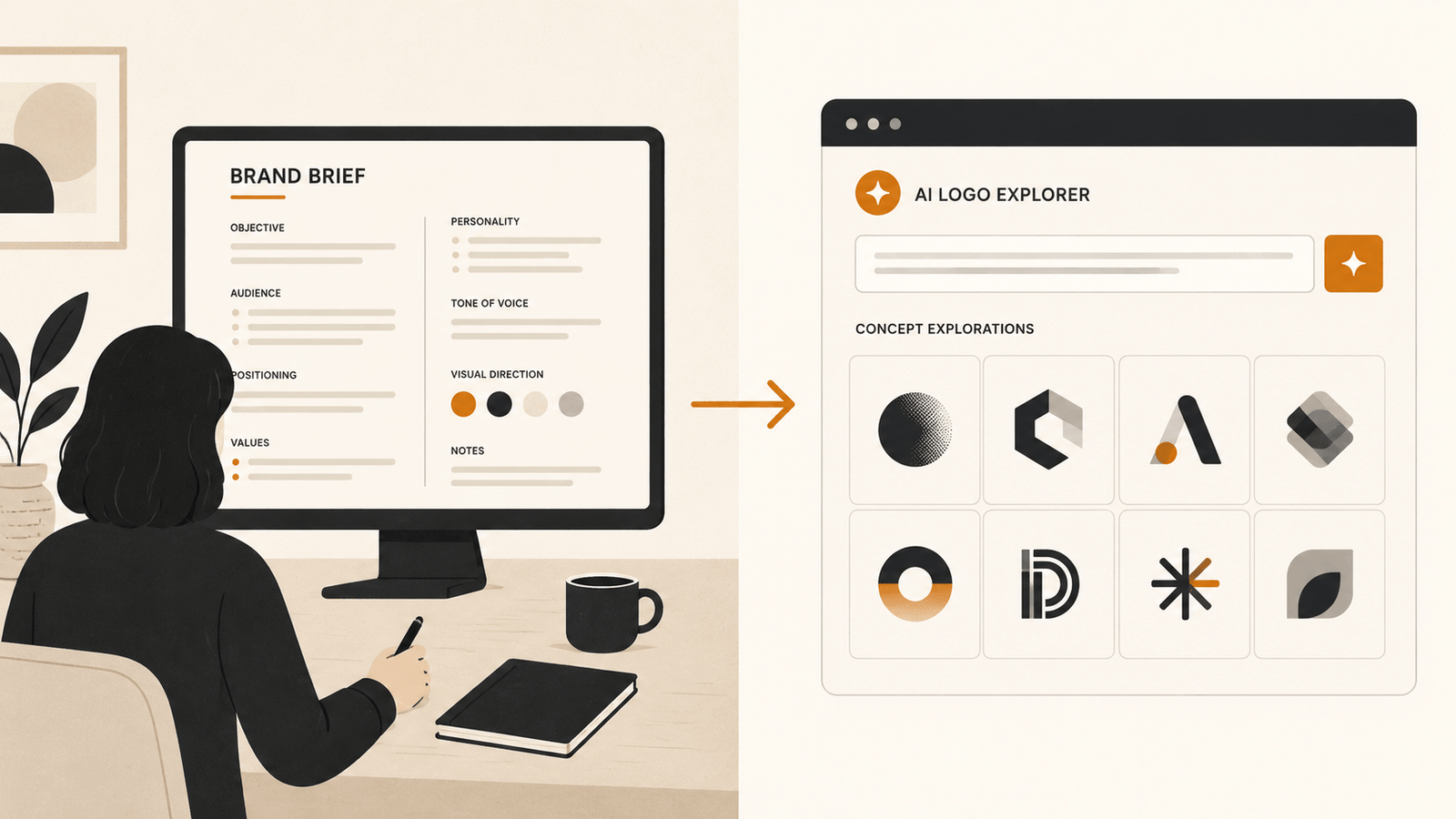
AI is excellent at execution under strategic direction. Given a genuinely specific brief, “We’re a B2B logistics tool for Southeast Asian SMEs, our tone is direct and slightly irreverent, our primary color is this specific shade of terracotta,” AI tools can generate visual explorations that save real time and budget. That’s a legitimate use of the technology.
The problem is using AI as a substitute for the brief. The brief is the brand strategy. It requires founder interviews, competitive analysis, customer research, and the kind of positioning decisions that involve real tradeoffs. No model can do that work for you. Not because the capability isn’t there, but because the inputs don’t exist until someone has done the thinking and made the choices.
Where AI genuinely saves time in a brand project: Visual exploration sprints: generating a wide range of logo concepts quickly to identify directions worth refining Copywriting variations: once tone of voice is defined, producing multiple headline options for testing Asset adaptation: resizing and reformatting existing brand assets across different contexts
Color exploration: starting from a confirmed direction and generating adjacent palette options Where it doesn’t replace strategic work: Defining what genuinely differentiates you from alternatives in your category Making positioning decisions that require real tradeoffs about who you’re for and who you’re not Building a visual signature with actual distinctiveness Creating the strategic foundation a brand can survive growth and pivots from The shortcut turns into a long detour when you skip the second list to get to the first.
What a Real Brand Identity Looks Like
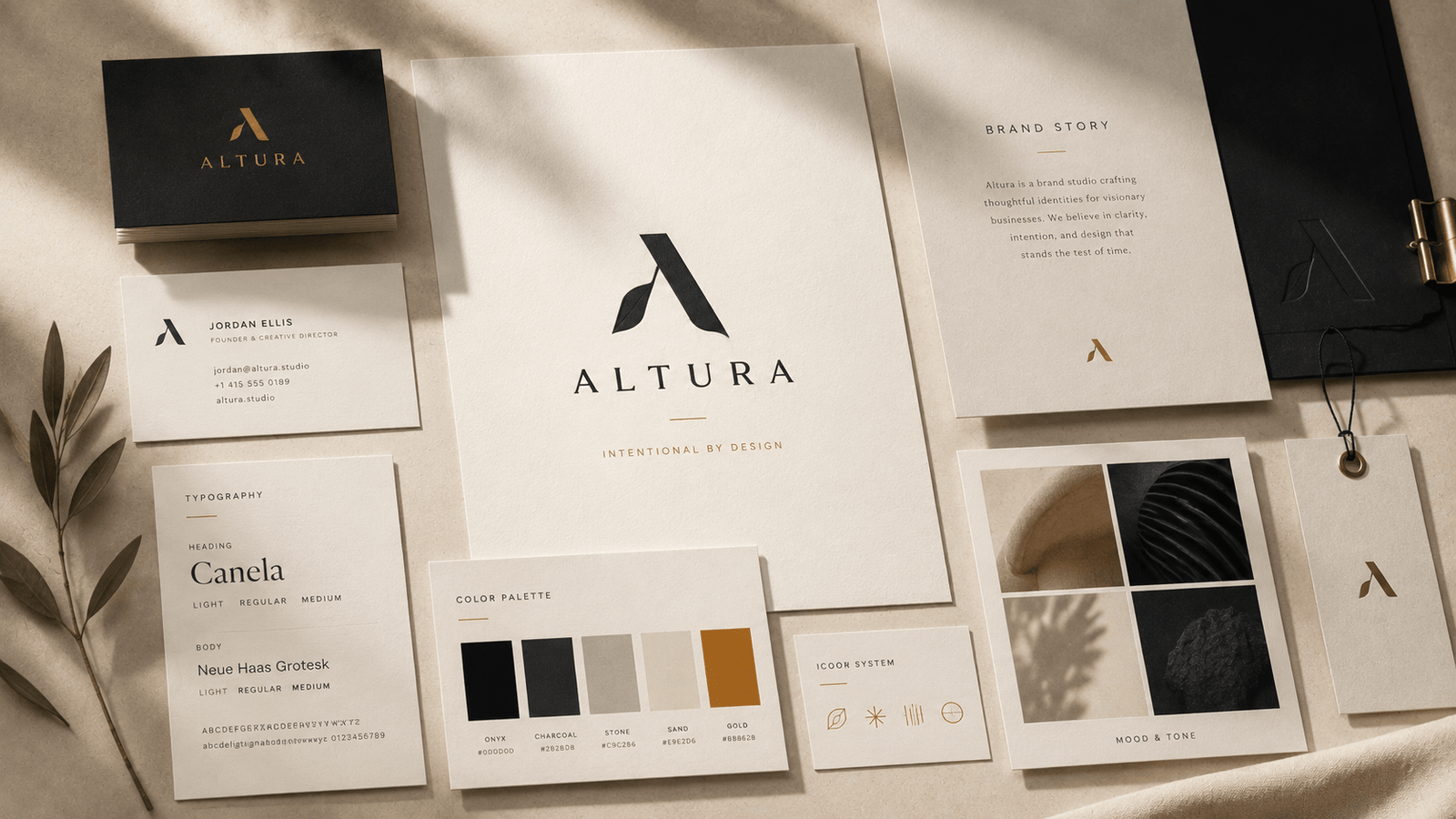
Real brand identity is the result of an honest conversation between what a company actually is, who it’s actually built for, and why that combination is genuinely different from everything else available. It takes specificity at every level: a name that carries meaning beyond sounding modern, a visual system where every decision has a reason behind it, a tone of voice that sounds like a specific person rather than a product category.
None of that is unknowable. It’s just not fast. A few things that separate a real brand system from polished AI output: It has a decision trail. Someone made the call about why this specific color and not that one, why this typeface over the more obvious choice, why this name even though it was harder to register. You can trace every element back to a deliberate reason.
AI-generated work has no such lineage. There’s nothing to defend when someone suggests changing it, because there was never a real argument for it in the first place. It creates problems for competitors. A strong brand identity makes it significantly harder for a direct competitor to say “we’re just like them but cheaper.”
When you’ve genuinely occupied specific visual and verbal territory with conviction and consistency, copying it makes you look like a copy. The distinctiveness becomes a moat. It makes internal decisions faster. A real brand brief functions as a filter. “Does this fit our voice? Does this look like us?” become answerable questions rather than open arguments.
Without a genuine identity, every design and copy decision gets contested from first principles. That’s slow and expensive when you’re trying to grow. At VedaCreatives, every brand project starts with a discovery process before a single visual decision is made. The strategic foundation, positioning, competitive landscape, personality, and tone, has to be solid before visual work is worth anything.
The identities we build hold up through funding rounds, team changes, and product pivots because they’re anchored in something real, not a prompt. You can explore how we approach brand identity work or reach out directly if you’re questioning whether your current brand is doing the work it should be.
Frequently Asked Questions
What exactly is AI slop in branding?
AI slop is what happens when generative tools produce brand assets (logos, names, copy, palettes) without strategic thinking behind them. The outputs look polished but are generic by design: trained on millions of existing brands, they regress toward average. The result is a brand that resembles dozens of competitors and differentiates against none.
Can't I just use AI tools and review the output carefully?
You can use AI tools — we do, for execution. The issue isn’t the tool, it’s skipping the strategic layer. If you haven’t defined your positioning, competitive differentiation, and brand personality first, reviewing AI output has no benchmark. You end up choosing what looks nice rather than what works.
How quickly can AI slop in branding hurt my business?
Faster than most founders expect. Investor meetings, key hires, and partnership conversations happen in the first 6-18 months post-funding. A brand that doesn’t earn immediate trust can quietly cost you those conversations before you even know it. The damage is hard to measure because you rarely get told: your brand looked generic.
Is a brand refresh expensive?
Less expensive than the cost of getting it wrong. A properly scoped brand project — positioning, identity system, and key assets — typically runs $8K-$25K depending on complexity. The cost of a rebrand after premature scaling (reprinting collateral, updating a product UI, resetting brand recognition with your audience) is almost always 3-5x that.
How do I know if VedaCreatives is the right fit?
Start a conversation. We work with funded founders, CTOs, and CEOs who are serious about building a brand that earns trust, not just looks good. If you’re pre-funding or need a quick logo, we’re probably not the right fit. But if you’re past that stage and want a brand that works as hard as your product does, reach out.