
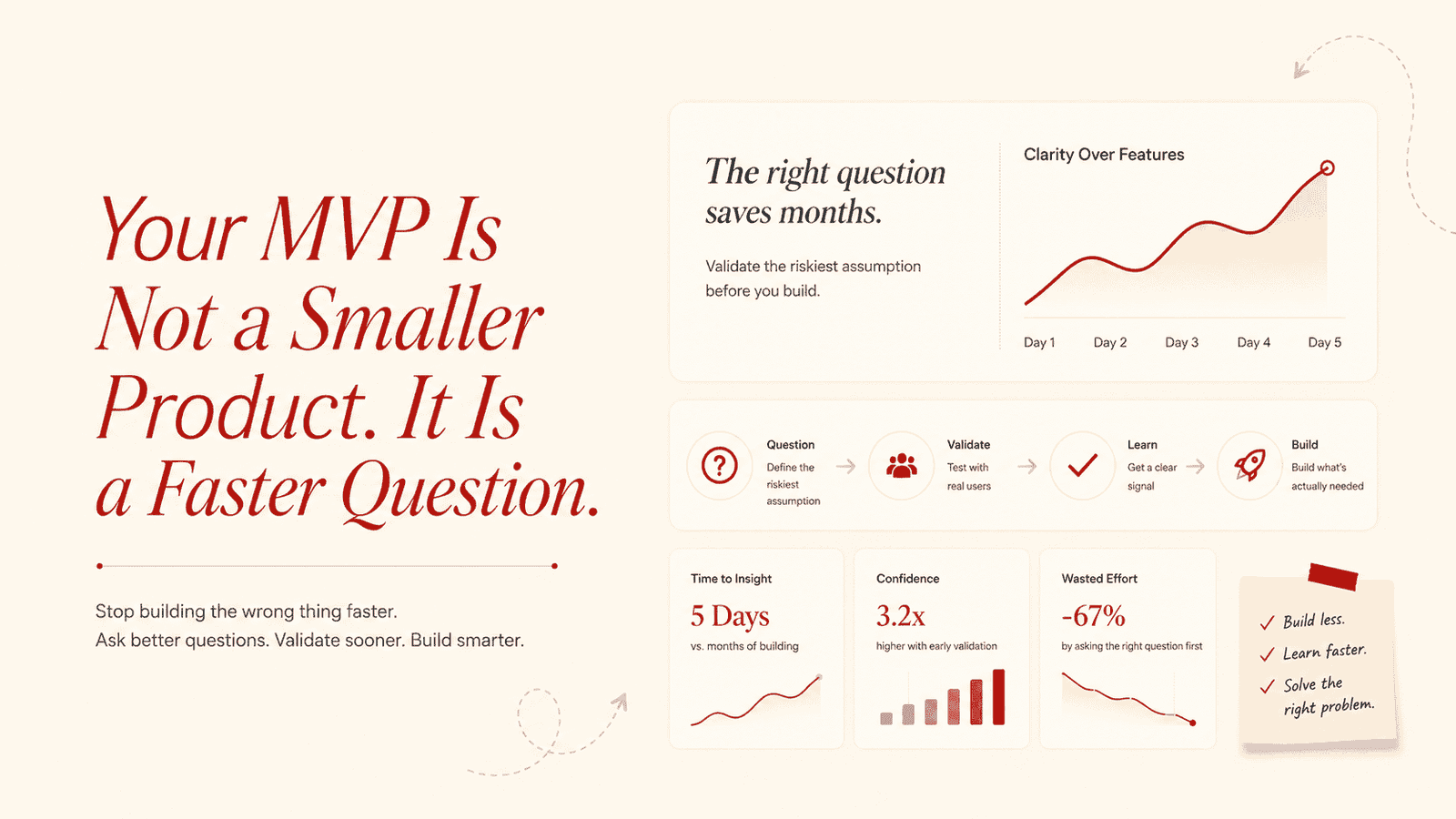
Why MVP Development for Startups Is About Validation, Not Features
Most founders treat the first version as a small copy of the product they imagine. That framing burns money. According to CB Insights’ analysis of startup failures, the single most common reason startups fail is building something the market does not want. When the first build is shaped with intent, mvp development for startups stops being a smaller product and starts becoming a faster question the market can answer.
The title is not a slogan. Eric Ries’ Lean Startup framework defines the minimum viable product as the version that lets a team collect the most validated learning about customers with the least effort. The point was never the smallness. The point is the learning. Teams that ship to learn move differently from teams that ship to launch.
At Tuvoc, we build first versions that are designed to produce evidence fast. This blog covers what that looks like in practice, how it protects your runway, and why the window to validate is shorter than most early teams assume.
MVP development for startups is the disciplined practice of building the smallest functional version of a product that can validate a core assumption with real users. Its job is to convert an untested idea into evidence, conserve limited runway, and shorten the time between a decision and the data that should drive it.

A Minimum Viable Product Exists to Test Demand, Not to Impress Early Users
MVP development for startups is not about shipping fewer features. It is about shipping the one thing that tells you whether anyone wants this at all. When you build to validate, every feature you cut is a question you chose not to waste money asking yet.
Demand is the first unknown, and it is the one most teams skip. According to CB Insights research, roughly 35% of startups that fail do so because there was no market need, the largest single category. A first build that proves or kills that assumption is worth more than a polished one that assumes it.
Validation, in that moment, is the product. A scrappy release that pulls real sign-ups teaches you more than a beautiful one that nobody returns to. The Build-Measure-Learn loop exists precisely to make that lesson cheap and fast.
Why Does Building a Full-Featured First Version Usually Waste a Startup’s Money?
Every feature you build before validation is a bet placed before the odds are known. mvp app development for startups works because it forces that bet to be small. Y Combinator’s startup library repeatedly makes the same point: launch something small, get it in front of users, and let their behavior tell you what to build next.
The waste is not just the code. It is the months spent building features for a problem nobody confirmed. Founders watching their runway shrink while polishing a settings page are usually solving the wrong problem first. The Single Core Loop principle resolves this: build only the one workflow that proves the value, then stop and watch.
- Unvalidated features are sunk cost: money spent before demand is confirmed rarely returns
- One proven loop beats ten guesses: a single working workflow generates real signal
What Should the First Release Actually Measure to Be Useful?
A useful first release measures behavior, not opinions. mvp development for startup teams that win instrument three things from day one: activation, retention, and a single conversion event that maps to value. Vanity metrics like raw signups feel good and decide nothing.
Opinions in surveys are cheap. Returning users are expensive to fake. The metric that matters is whether someone who tried the core action came back to do it again. The North Star Metric framework names this: pick the one number that best captures delivered value, and let it govern the roadmap.
- Retention is the honest signal: people return only when something works for them
- One conversion event, tracked clean: tie the metric to real value, not page views
How Do You Decide Which Single Feature Defines Your MVP?
The defining feature is the one that, if removed, makes the product pointless. mvp development services for startups usually start by mapping the user’s job-to-be-done and cutting everything that is not on the critical path to that job. Marty Cagan’s product writing at SVPG frames this as finding the smallest solution that is valuable, usable, and feasible at once.
Most early roadmaps are too generous. The hard discipline is saying no to good ideas so the one essential idea ships this month instead of next quarter. Jobs-to-be-Done is the named lens here: define the progress the user is trying to make, then keep only the steps that deliver it.
- Cut to the critical path: if removing it doesn’t break the value, it waits
- Ship the essential, defer the nice: one valuable loop now beats a full suite later
What an MVP Tests vs What Founders Think It Should Show
| Founder Instinct | What the MVP Should Do |
|---|---|
| Show the full product vision | Test one core assumption |
| Impress with polish and features | Generate real user behavior data |
| Avoid launching until it's ready | Launch early to start learning |
| Measure signups and downloads | Measure activation and retention |
| Build for the imagined user | Build for the observed user |
Scope Discipline Is What Turns a Limited Runway Into Enough Runway
spending your months on the work that buys more months. A tight scope is not a compromise; it is how a short runway becomes long enough to find product-market fit.
Runway is the constraint everything else bends around. According to CB Insights data, running out of cash is the second most common cause of startup failure, close behind no market need. Scope is the lever founders actually control over that timeline.
Spend less to build, and you have more time to learn. The teams that survive are rarely the ones that built the most. They are the ones that learned the most per dollar before the money ran out.
How Much Runway Does a Focused MVP Realistically Save a Startup?
A focused build typically reaches first real users in weeks, not quarters. mvp development for tech startup teams that scope tightly often ship a testable version in 8 to 12 weeks, where a full-feature build can run 6 to 9 months. That difference is months of payroll preserved before any revenue exists.
The saved time is not just cheaper. It is optionality. Reaching evidence sooner means you can pivot, double down, or stop while you still have cash to act on what you learned. Timeboxing is the named discipline: fix the date, flex the scope, and ship on schedule.
- Weeks to evidence, not quarters: tight scope shortens time-to-learning sharply
- Saved months are saved options: cash left over funds the next decision
Why Does Feature Creep Quietly Drain a Startup’s Budget?
Feature creep rarely arrives as one big decision. It arrives as ten small yeses. mvp development for startup budgets die from scope that expands a little each week until the launch date and the bank balance both slip. Each added feature also adds testing, maintenance, and coordination cost that compounds.
The danger is that every individual feature sounds reasonable. The damage is only visible in aggregate, when the simple build has quietly become a complex one. A Scope Freeze before the build starts is the named guardrail: lock the feature set, and route every new idea to a parked backlog.
- Small yeses compound into delay: each feature drags testing and upkeep behind it
- Freeze scope, park ideas: a locked feature set protects the launch date
What Is the Right Way to Sequence Features Against a Burn Rate?
Features should be sequenced by how much each one reduces your biggest unknown per dollar. mvp app development for startups benefits from ordering work so the riskiest assumption gets tested first, while burn is lowest. Lean Startup principles call this validated learning: spend first on the experiment that could most change your direction.
Building the easy, safe features first feels productive and teaches nothing. Building the scary, defining feature first is uncomfortable and tells you whether to continue at all. Riskiest-Assumption-First is the named ordering: tackle the bet that could kill the company before you spend on the rest.
- Test the riskiest bet first: spend early dollars where they change the answer
- Safe features teach the least: comfort work delays the verdict that matters
Where a Startup’s Runway Goes: Drained vs Defended
| Runway-Draining Behavior | Runway-Defending Behavior |
|---|---|
| Open-ended feature scope | Locked MVP scope before build |
| Building safe features first | Testing riskiest assumption first |
| 6 to 9 month first build | 8 to 12 week first build |
| Polish before validation | Validation before polish |
| Cash spent on assumptions | Cash spent on evidence |
Speed to First Users Is a Learning Rate, Not Just a Launch Date
The mvp development for tech startup advantage is not bragging about a fast launch. It is that shipping sooner means deciding sooner. Every week between your idea and a real user is a week your assumptions stay unverified.
Learning velocity is the real metric. Y Combinator’s core advice to founders is blunt: launch now and iterate, because the market teaches faster than any internal debate. Speed to users is speed to truth.
A team that ships in six weeks and iterates weekly runs far more experiments than one that ships in six months. The first team is not just faster; it is smarter sooner, because it has more real data and less guessing.
Why Does Shipping Sooner Beat Shipping More Complete?
A complete product launched late answers your questions late. mvp development for startups wins because an incomplete product in front of real users answers them now. The Lean Startup frames every release as an experiment; the sooner it runs, the sooner you can correct course.
Completeness is a comfort, not a strategy. The market does not grade you on how finished the first version looked. It grades you on whether you learned the right thing before the money ran out. Continuous deployment is the named enabler: small, frequent releases turn each week into a fresh experiment.
- Early and rough beats late and full: real users answer questions debates cannot
- Each release is an experiment: ship small, learn, correct, repeat
How Fast Can a Startup Realistically Get a Usable MVP in Front of Users?
With tight scope and the right team, a usable first version reaches users in 6 to 12 weeks for most software products. mvp development services for startups hit that range by building one core loop on proven tooling rather than custom infrastructure. No-code and managed services can compress simple validations to days.
The timeline stretches only when scope or perfectionism creep in. The build itself is rarely the bottleneck; the decisions about what to build are. A weekly release cadence is the named rhythm: commit to shipping something users can touch every week, even if small.
- 6 to 12 weeks is the working range: one core loop on proven tooling
- Weekly cadence keeps momentum: ship something testable every week
What Slows Most First Builds Down, and How Do You Avoid It?
The biggest slowdown is rarely technical. It is indecision about scope and a fear of launching imperfect work. mvp development for startup stalls when founders keep adding ‘just one more thing’ before they will show anyone. SVPG’s product guidance stresses shipping to learn over shipping to look finished.
Technical debt taken on knowingly is fine at this stage; you may throw the code away once you learn. The fatal slowdown is emotional, not architectural. A public launch deadline is the named forcing function: set a date others know about, and let it end the polishing.
- Indecision is the real delay: scope drift outweighs any coding bottleneck
- A hard date ends the polishing: a known deadline forces the ship decision
Slow First Build vs Fast First Build
| Slow Learning Loop | Fast Learning Loop |
|---|---|
| Six-month first release | Six-to-twelve-week first release |
| One big launch, then wait | Weekly releases, constant signal |
| Polish before any user sees it | Users see it rough and early |
| Custom infrastructure from day one | Proven tooling and managed services |
| Few experiments per quarter | Many experiments per quarter |
The Team You Choose Decides How Fast Your Idea Becomes Evidence
MVP development services for startups are not just a way to get code written. The team model you pick directly sets your time-to-evidence, your burn rate, and how cleanly you can pivot when the data tells you to. The build-versus-buy decision is really a speed decision. According to CB Insights research, team problems rank among the top reasons startups fail. Who builds your first version shapes whether you reach evidence before your runway ends. A founder who can code may move fastest at the very start. A specialized partner may move fastest to a production-ready, scalable validation. The right answer depends on what you are testing and how much runway you are willing to spend learning to build. A partner that combines development with dedicated UI/UX design can also shorten the feedback loop between what users experience and what gets refined next. Should a Startup Build the MVP In-House or Use a Development Partner? The choice comes down to where your scarce time is best spent. mvp app development for startups built in-house keep full control but consume founder hours on hiring and setup. A partner trades some control for speed, because the team, tooling, and process already exist. Neither is universally right. A technical founder validating a simple idea may build it themselves in a weekend. A non-technical founder with a complex idea will reach evidence faster by borrowing an experienced team. Build-Buy-Borrow is the named decision frame: build if it’s your edge, buy if it’s solved, borrow if speed matters most. In-house keeps control, costs time: founder hours go to hiring and setup A partner trades control for speed: team and process already exist on day one What Should Founders Look for in an MVP Development Partner? Look for a partner who pushes you to build less, not more. mvp development for tech startup partners worth hiring challenge scope, ship in weeks, and instrument the product so you get real data, not just a demo. A partner who says yes to every feature is a warning sign. Experience with your stage matters more than a long portfolio. A team that has taken many first versions from idea to validated learning will protect your runway better than one optimized for big enterprise builds. Stage-fit is the named filter: match the partner to your phase, not just their resume. They should shrink your scope: a partner who cuts features protects your runway Stage fit beats portfolio size: match the team to the validation phase How Does the Team Model Affect Your Ability to Pivot Later? A rigid, heavily custom first build is expensive to change when the data says pivot. mvp development for startups should be built so the lessons survive even if the code does not. The team that builds with throwaway-friendly architecture keeps your pivot cheap. The goal at this stage is learning, and learning often means changing direction. A team that over-invests in permanent infrastructure makes the inevitable pivot painful and slow. Disposable Architecture is the named principle: build the validation to be replaced, not preserved, so changing course stays cheap. Build to be replaced, not kept: throwaway-friendly code keeps pivots cheap Protect the lesson, not the code: learning should outlast the first build MVP Team Models Compared
| Common Assumption | What Actually Drives Time-to-Evidence |
|---|---|
| Hire a full team immediately | Match team size to validation scope |
| Most code equals most progress | Most learning per dollar equals progress |
| Build everything custom | Use proven tooling, build only the edge |
| Permanent architecture from day one | Disposable architecture for fast pivots |
| Pick the biggest portfolio | Pick the best stage fit |
The MVP Decisions You Make Now Set the Company You Can Become Later
MVP development for startups is not a throwaway phase you rush past. The choices you make about scope, speed, and evidence in the first three months shape how confidently you can raise, hire, and scale in the next eighteen.
Early evidence compounds into later credibility. Y Combinator’s guidance to founders is that traction, even small and early, is the strongest signal an investor can see. The MVP is where that traction story begins or stalls.
Founders who treat the first build as a learning engine arrive at their seed round with data. Founders who treat it as a launch arrive with a story and a hope. Investors can tell the difference instantly.
Why Do Early MVP Choices Shape a Startup’s Fundraising Story?
Investors fund evidence, not ambition. mvp development for startup that produces real usage data gives a founder something concrete to point to: people use this, and they come back. That is a far stronger pitch than a roadmap and a vision deck.
The MVP decides whether your fundraising conversation is about traction or about potential. Traction raises money faster and at better terms. Traction-Led Fundraising is the named approach: let the usage data carry the pitch, and use the deck to explain it.
- Data beats ambition in a pitch: real usage outperforms a vision slide
- Traction sets the terms: evidence raises faster and at better valuations
How Does an MVP-First Approach Affect Hiring and Early Culture?
A team that ships and learns early builds a culture of evidence over opinion. mvp development services for startups set the tone: decisions get made by data, not by whoever argues loudest. That habit, formed early, scales with the company.
The first few hires absorb whatever rhythm the founders set. If the first build was a fast learning loop, new engineers inherit that. If it was a long, secretive polish, they inherit that instead. Evidence Culture is the named outcome: the validation habit becomes the company’s default operating mode.
- Early habits become company habits: the first build sets the operating rhythm
- Evidence over opinion, from day one: data-led decisions scale with the team
What Does a Scalable Path Out of the MVP Stage Look Like?
The clean path is to harden what worked and discard what didn’t, only after the data is in. mvp development for tech startup graduates to a real product when a validated core loop gets rebuilt for reliability and scale, not before. Premature scaling is its own failure mode.
Scaling an unvalidated product is how teams build robust infrastructure for something nobody wants. The Lean Startup warns against this directly: validate first, then invest in scale. Validate-Then-Harden is the named sequence: prove the loop, then rebuild it to last.
- Harden only what’s validated: rebuild for scale after the data confirms it
- Premature scale is wasted scale: infrastructure for an unwanted product is loss
Early MVP Decisions and Their Delayed Outcomes
| Early MVP Decision | Company-Level Effect 12 to 18 Months Later |
|---|---|
| Build to learn, ship early | Fundraise with real traction data |
| Tight scope, defended runway | More months to find product-market fit |
| Evidence-led decision habit | Data-driven culture that scales |
| Disposable validation architecture | Cheap, fast pivots when needed |
| Validate before hardening | Scale built on a proven core loop |
Frequently Asked Questions: MVP Development for Startups
What exactly is an MVP for a startup?
It is the smallest functional version of your product that can test one core assumption with real users. Its job is to produce evidence, not to showcase the full vision. If it answers your biggest question, it is doing its job.
How long should MVP development for startups take?
For most software products, 6 to 12 weeks with tight scope and the right team. The build is rarely the bottleneck. Indecision about what to build is what stretches timelines into quarters.
How much does it cost to build an MVP?
It depends entirely on scope, but the goal is to spend the least amount that still produces real validation. A focused first build conserves runway; an open-ended one drains it. Cost follows scope discipline, not the other way around.
Should I build the MVP myself or hire a development partner?
Build it yourself if coding is your edge and the idea is simple. Borrow an experienced team if speed to evidence matters and the idea is complex. The right choice is whichever reaches validated learning before your runway ends.
What should an MVP measure to know if it's working?
Activation and retention, plus one conversion event tied to real value. Signups and downloads feel good and prove nothing. The honest signal is whether users who tried the core action came back to do it again.
What is the most common MVP mistake founders make?
Building too much before validating anything. Feature creep turns a six-week build into a six-month one and burns the runway on assumptions. The fix is to lock scope and test the riskiest assumption first.
When is a startup ready to move beyond the MVP?
When a core loop is genuinely validated by user data, not before. At that point you harden it for reliability and scale. Scaling an unvalidated product just builds solid infrastructure for something nobody wanted.